
Full Breakdown
Grand Jury Declines to Indict Former White House Aide Cassidy Hutchinson
By Drooid · · How we work
In this breakdown
01
Background & Context
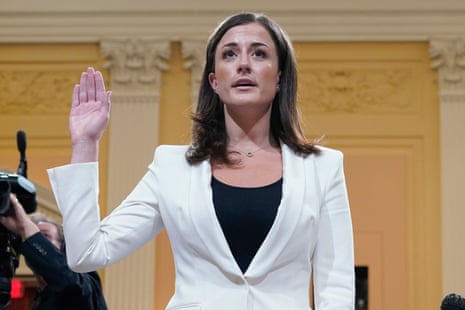
Cassidy Hutchinson, senior aide to former White House chief of staff Mark Meadows, testified before the House Select Committee on Jan. 6, 2021. She said President Donald Trump knew some supporters were armed, urged removal of magnetometers at his rally, and tried to join the Capitol mob. She also relayed a second-hand account that Trump lunged at his limousine’s steering wheel after a Secret Service agent refused to drive him to the Capitol; the driver later denied the incident. Republican lawmakers accused her of perjury and referred her to the Justice Department, whose Civil Rights Division—led by Trump appointee Harmeet Dhillon—handled the probe.
Watch
Related reporting
cbsnews
Video: CBS News 24/7
02
Timeline
- January 6, 2021 – Trump supporters attacked the Capitol.
- June 28, 2022 – Hutchinson testified before the House committee.
- July 12, 2022 – A text from Hutchinson to Secret Service Assistant Director Anthony Ornato was shown during the committee’s seventh hearing.
- October 27, 2026 – A Washington, D.C., federal grand jury issued a “non-concurrence,” declining to indict Hutchinson on charges related to her testimony.
Visual evidence
Images from the story



03
Official Statements & Responses
A senior U.S. official told NBC News the grand jury returned a “no bill,” meaning the indictment request was rejected. In court, a Justice Department attorney informed Magistrate Judge Zia Faruqui that the grand jury had not concurred on the proposed indictment; the attorney did not name Hutchinson publicly. The Justice Department has not commented, and Hutchinson’s lawyers have not responded to requests for comment.
Attorney General Todd Blanche, speaking in April, said grand-jury rejections are part of the department’s broader investigative work, noting jurors “don’t get everything right.” Department policy requires notifying the magistrate judge when a grand jury declines an indictment, a rule newly enforced this year.
04
Criticism & Opposition
President Trump dismissed Hutchinson’s testimony as “total phony” on Truth Social. Republican Senator Bill Cassidy called the DOJ’s effort “lawfare” directed by the president. House Republicans have urged the department to drop the investigation, arguing the testimony was unreliable.
05
Conflicting Reports & Gaps
Sources differ on which portions of Hutchinson’s testimony prosecutors targeted. Some say the focus was on alleged false statements about Trump’s behavior; others note the investigation also considered possible obstruction of justice. Neither the Justice Department nor the grand jury disclosed precise charges or evidentiary standards, leaving the legal basis for the indictment request unclear.
06
Impact & Significance
The grand jury’s refusal to indict adds to a pattern of “no-bill” outcomes in high-profile DOJ cases since Trump’s return to office in 2025. The decision does not bar the department from presenting the case to another grand jury. The episode highlights challenges in prosecuting alleged perjury from congressional testimony, especially when evidence relies on second-hand accounts and key witnesses dispute critical details.