
Full Breakdown
China’s Reusable Spaceplane: New DIA Image and Mission Overview
By Drooid · · How we work
In this breakdown
01
Core Event – DIA Publishes First Clear Photo of China’s Secretive Spaceplane
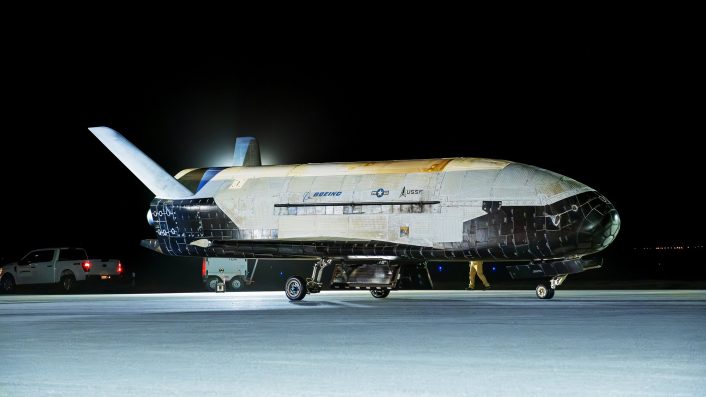
On October 27 2026, the U.S. Defense Intelligence Agency (DIA) released a report titled *Challenges to Security in Space* that includes the clearest publicly available image of China’s reusable orbital vehicle. The photograph, captured by a Maxar Technologies satellite in 2024, shows the underside of the spacecraft with its service module and solar arrays deployed. The DIA did not identify whether the vehicle is the “Shenlong” or “Tengyun” model, and it noted that the design, payload, and mission objectives remain largely undisclosed. Analysts have compared the Chinese vehicle to the U.S. Space Force’s X-37B orbital test vehicle because both are uncrewed, reusable, and capable of returning to Earth.
02
Background & Context
China’s experimental spaceplane has completed four orbital missions since its first launch in September 2020 aboard a Long March 2F rocket from the Jiuquan Satellite Launch Center. Prior to the Maxar image, public observations were limited to ground-based telescope sightings and artist renderings. The DIA report aggregates tracking data that show the spacecraft performing rendezvous and proximity operations (RPO) with secondary objects, but the agency stopped short of labeling the vehicle as a weapon system.
Visual evidence
Images from the story
03
Timeline
- August 4 2022 – Second launch; mission lasted 276 days, ending May 8 2023.
- December 2023 – Third launch; mission lasted 268 days, returning later this month.
- February 2026 – Fourth launch, currently in orbit.
- September 10 and September 13 – Reported rerendezvous and recapture of a sub-satellite during the third mission.
- October 27 2026 – DIA releases report and Maxar image.
- September 23 2026 – Astronomer Jonathan McDowell comments on the spacecraft’s proximity operations.
04
Data & Statistics
- Four missions completed or underway, with orbital durations of 2 days, 276 days, 268 days, and the ongoing fourth mission.
- Tracking data indicate the spaceplane operated within 1 km of a companion satellite, at times closing to within 100 m.
- The vehicle’s service module provides power and propulsion before separating ahead of re-entry, mirroring the X-37B’s architecture.
- Observed activities include multiple deployments, formation flying, and at least two capture/docking events with an object designated “Object J” (NORAD ID 54218).
05
Criticism & Opposition
Analysts have questioned the completeness of the DIA’s satellite inventory. Senior Fellow Todd Harrison observed:
“What those numbers don’t tell you is that the slope of the curve has leveled off in recent years — the number of satellites is not increasing as fast,” — Senior Fellow Todd Harrison
He added that the growth rate of China’s satellite fleet has slowed, suggesting that raw counts may not fully capture capability trends.
06
Conflicting Reports & Gaps
- The DIA could not confirm whether the photographed vehicle is the Shenlong or Tengyun model.
- The precise function of the visible payload-bay doors and the identity of the sub-satellite involved in RPO remain undisclosed.
- While Chinese officials emphasize peaceful objectives, U.S. analysts note that the dual-use nature of the technology leaves the platform’s potential military applications uncertain.
07
Verbatim Quotes
- “What those numbers don’t tell you is that the slope of the curve has leveled off in recent years — the number of satellites is not increasing as fast,” — Todd Harrison, Senior Fellow, American Enterprise Institute.