
Full Breakdown
New Dwarf-Planet Candidate 2026 ED138 Discovered Beyond Pluto
By Drooid · · How we work
In this breakdown
01
Discovery Overview
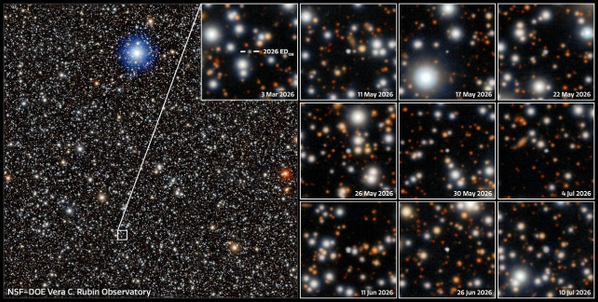
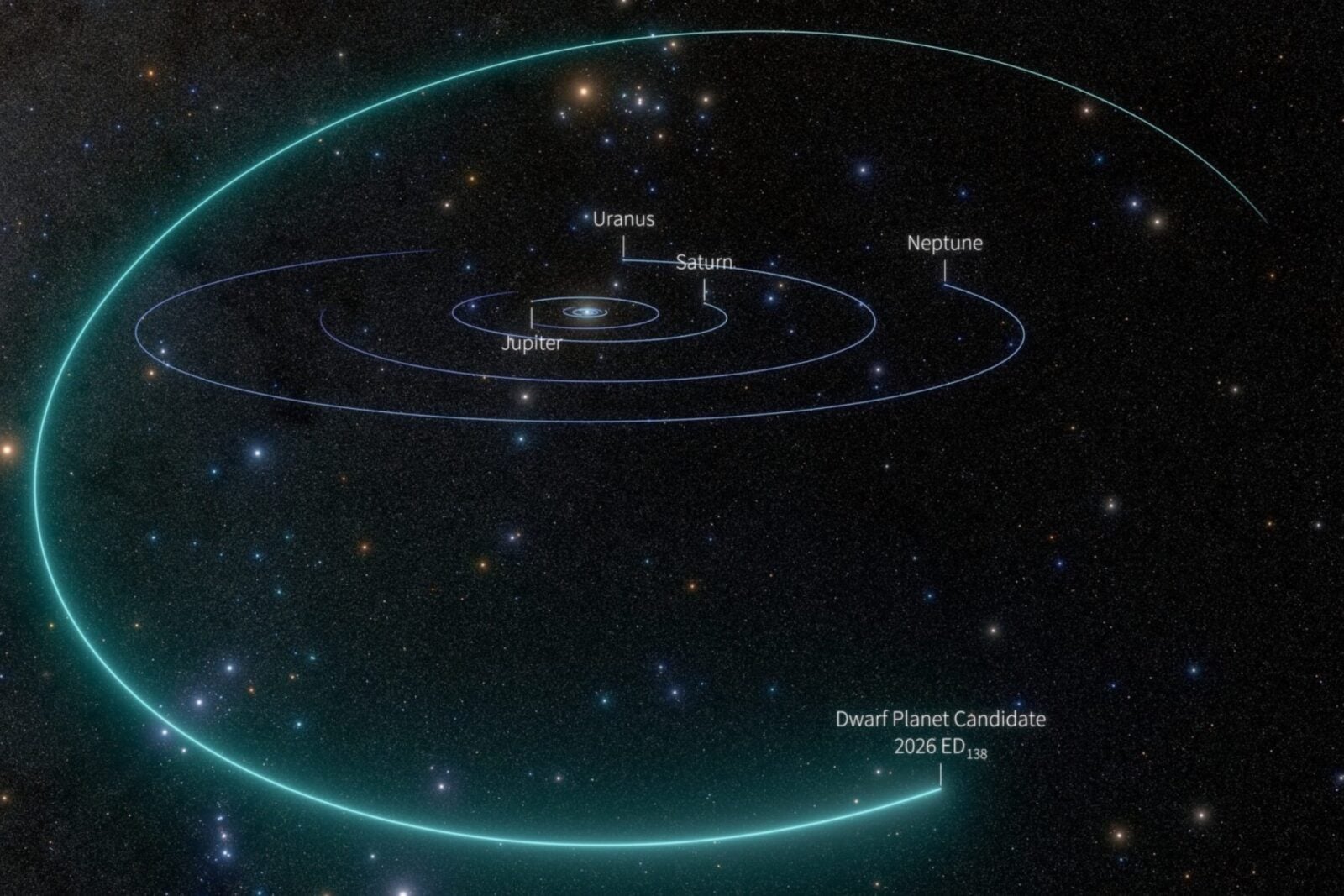
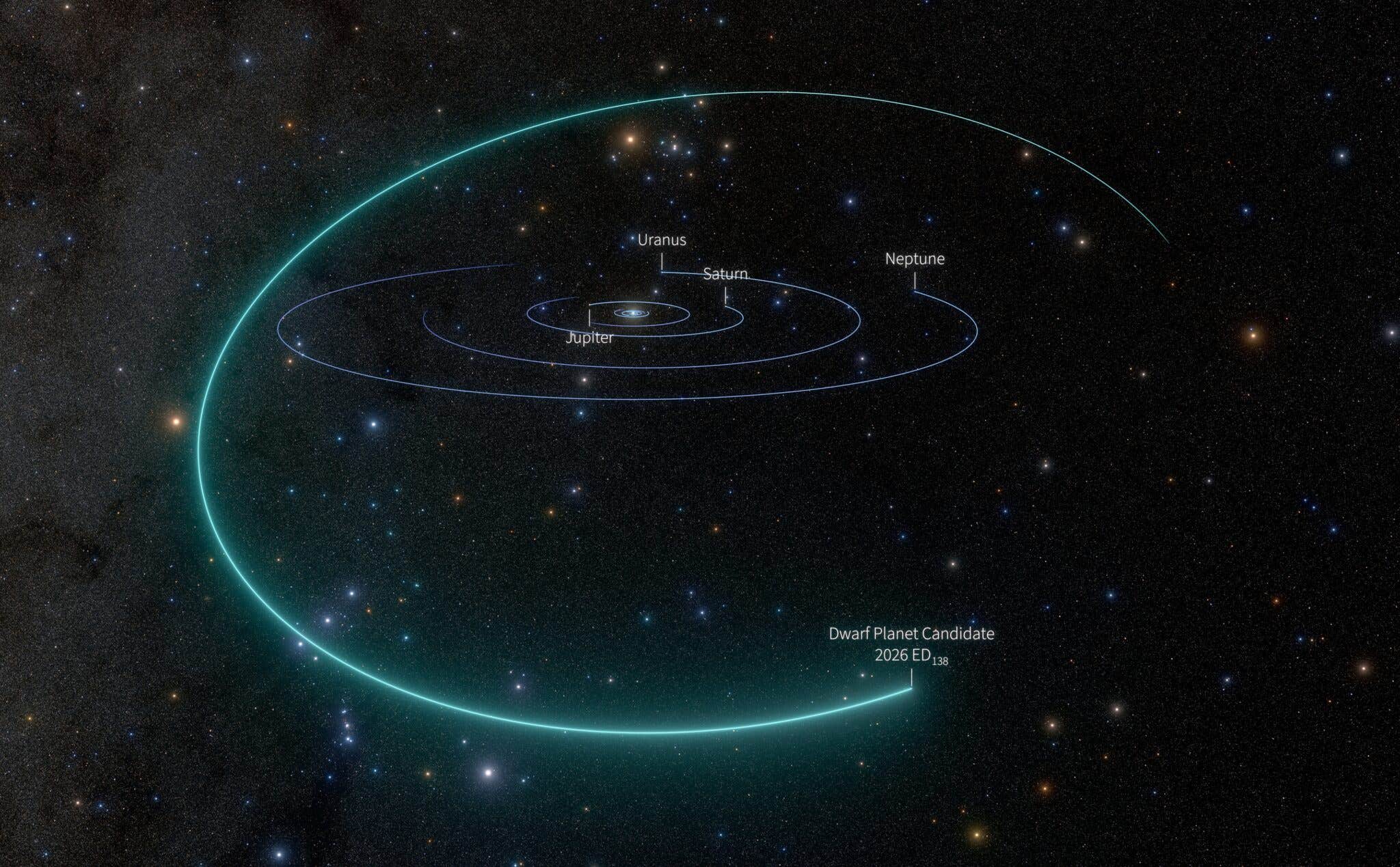
On October 13, 2026 astronomer Matt Holman of the Center for Astrophysics | Harvard & Smithsonian identified a moving point of light in data from the Vera C. Rubin Observatory in Chile. The object, provisionally designated 2026 ED138, lies at about 46 AU from the Sun—farther than Pluto’s average distance. Initial analysis classifies it as a trans-Neptunian object (TNO) and a dwarf-planet candidate pending confirmation of its size and shape.
02
Observational Data and Size Estimates
The Rubin telescope recorded 30 detections on 20 nights between March 4 and July 11, 2026. Archival images extend the observational arc back to 2016, allowing a preliminary orbit. Brightness and distance give a diameter estimate of 600–1 500 km (? 370–930 mi), reflecting uncertainty in surface reflectivity (albedo).
Visual evidence
Images from the story




03
Orbital Characteristics and Classification Criteria
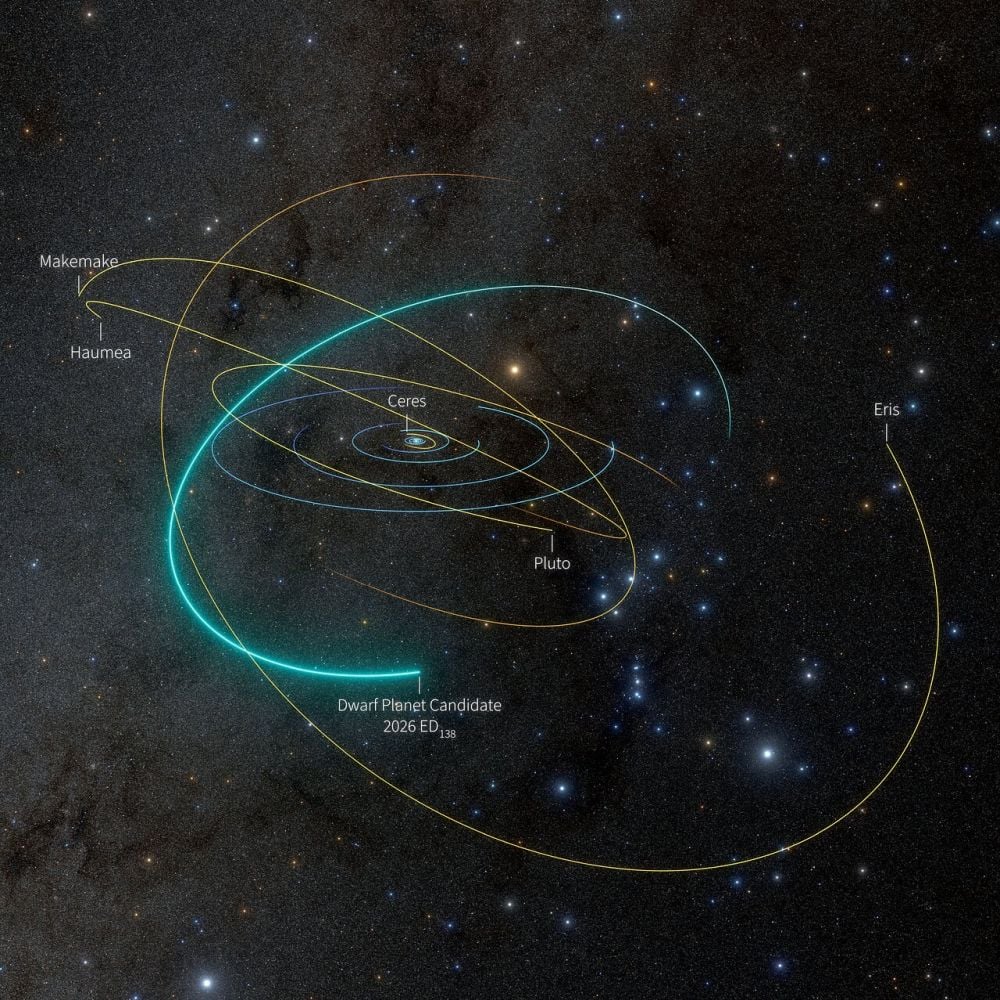
ED138’s orbit is tilted about 25° relative to the ecliptic, placing it in the “hot-classical” TNO population—objects likely perturbed by past interactions with Neptune. The IAU defines a dwarf planet as a body that orbits the Sun, is massive enough for self-gravity to achieve a roughly spherical shape, and has not cleared its orbital neighborhood. The current size estimate suggests ED138 may satisfy the roundness criterion, but precise mass and shape measurements are still required.
04
Significance for Solar-System Science
If confirmed, ED138 would become the sixth recognized dwarf planet, joining Ceres, Pluto, Eris, Haumea, and Makemake. Its discovery highlights the Rubin Observatory’s ability to uncover faint, distant worlds missed by earlier surveys, especially near the Milky Way’s plane, and adds a new data point for models of Kuiper-Belt formation and Neptune’s early migration.
05
Official Statements & Responses
- Matt Holman emphasized that determining the object’s physical size is the primary next step.
- Edward Ajhar, NSF program director for Rubin, described the telescope’s “superpower” to capture movement among vast numbers of objects.
06
Verbatim Quotes
- “my first reaction was one of excited disbelief,” — Matt Holman
- “Rubin is giving us an unprecedented capacity to explore the sky through a combination of speed, depth, and precision,” — Mario Juri
07
Next Steps and Future Observations
Researchers plan infrared observations—potentially with the James Webb Space Telescope—to measure thermal emission and refine size and albedo. Additional astrometric tracking will improve the orbit, while stellar-occultation campaigns could directly constrain the diameter. The Rubin Observatory will continue its ten-year Legacy Survey of Space and Time (LSST), likely revealing more distant bodies.