
Full Breakdown
Japan-Germany Strategic Partnership Expands Amid China-US Tensions
By Drooid · · How we work
In this breakdown
01
Core Event: Joint Declarations on Economic Security and Technology (Oct 28, 2026)
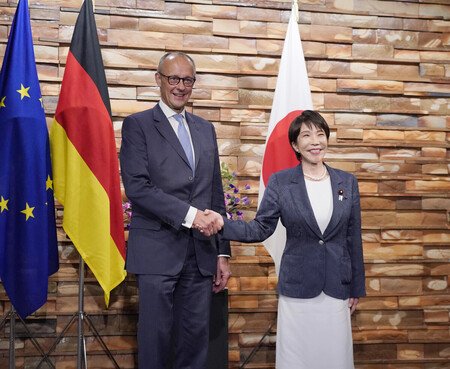
On Oct 28, 2026 Japanese Prime Minister Sanae Takaichi and German Chancellor Friedrich Merz met at the Japanese prime minister’s office in Tokyo. The leaders issued joint declarations covering economic security, critical minerals, artificial intelligence, nuclear fusion and defence cooperation. They announced plans to sign 33 memoranda of understanding on cutting-edge technologies and discussed expanding collaboration on the Global Combat Air Programme (GCAP), a fighter-jet project led by Japan, Italy and the United Kingdom.
02
Background & Context
The meeting follows a series of diplomatic moves by both governments to reduce reliance on China for rare-earth minerals and other strategic inputs. Beijing’s tighter export controls on dual-use products to Japan have heightened concerns about “economic coercion.” Germany, seeking to diversify its trade away from both the United States and China, views deeper ties with Japan as a cornerstone of a broader European-Asia partnership.
Visual evidence
Images from the story
03
Data & Statistics
- 33 MoUs are slated for signing on AI, nuclear fusion and related technologies.
- China supplies the majority of global rare-earth minerals; recent export restrictions have slowed Japanese imports of certain elements.
- The European Union’s trade deficit with China reached €360 billion in 2025, roughly €1 billion per day.
04
Official Statements & Responses
Both leaders stressed that closer defence, energy and technology cooperation is essential for regional stability.
05
Verbatim Quotes
- “Japan, the European Union, and Germany have all come to realise that we must reduce one-sided dependencies -- whether in our supply chains or regarding raw materials,” — Friedrich Merz, German Chancellor
- “As a permanent member of the Security Council, China bears a particular responsibility for upholding international law. China’s voice carries weight in Moscow. We encourage China to use her power to help bring about a just peace in Ukraine, rather than enabling Moscow’s war of aggression.” — Friedrich Merz, German Chancellor
- “If not, I would like to see as a step in between to have preliminary FTAs with those who are in this area and willing to move forward. But the best way to move forward would be a bloc-to-bloc agreement.” — Ian Storey, researcher, ISEAS – Yusof Ishak Institute
06
What's Next
German officials plan to meet Japanese defence ministers in the coming weeks to discuss potential industrial contributions to the GCAP programme. Both governments intend to pursue additional agreements on critical mineral supply chains and to explore a broader Europe-Asia free-trade framework later in the year.