
Full Breakdown
Akai Expands Portable Sampler Line with Open-Source Firmware and Keyboard Variant
By Drooid · · How we work
In this breakdown
01
Core Release: MPC Sample Launch and Sample Key Teaser
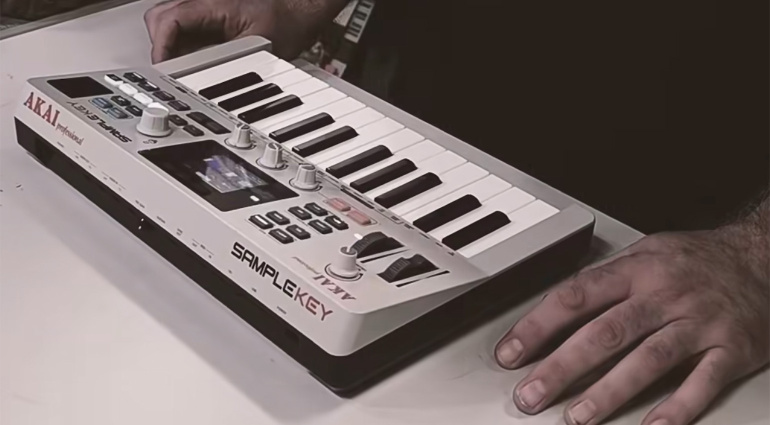
Akai Professional introduced the battery-powered MPC Sample on March 24 2026, a compact hardware sampler inspired by the vintage MPC 60 and MPC 3000. Within days, the company posted Instagram teasers for a keyboard-based counterpart, the Sample Key, noting that its firmware will be open for community modification. The teasers feature custom sound engines built with AI-assisted coding tools, but Akai has not disclosed specifications, pricing, or a release schedule for the Sample Key.
02
Background & Context
The launch arrives amid a resurgence of affordable hardware samplers, a trend noted in a March 5 2026 overview that cited the Roland SP-404Mk2, Teenage Engineering EP-133 K.O II, and a new Casio sampler unveiled at NAMM 2026. Akai’s stated goal is to compete directly with the SP-404Mk2, offering a portable alternative at a lower price point.
Visual evidence
Images from the story




03
Technical Overview
The MPC Sample measures 23.6 × 19.4 × 5.0 cm and runs on a CPU with 2 GB RAM and 8 GB internal storage, expandable via microSD. It features a 2.4-inch full-color display, 16 RGB-backlit velocity-sensitive pads, three control knobs, and a “legacy MPC parameter” knob. Sampling can be performed through stereo 6.3 mm inputs, a built-in microphone, or USB-C, and the device ships with over 100 factory kits.
Audio processing includes 60 effects such as granulator, ring-mod, lo-fi, delay, reverb, half-speed, and beat repeat, plus real-time timestretch, pitch shift, and an internal resampling option. Connectivity comprises a rechargeable lithium-ion battery (?5 hours), headphone jack, sync out, MIDI IN/OUT (TRS), stereo I/O, and USB-C for audio and data. Projects created on the MPC Sample can be opened in Akai’s MPC 3 software for further editing.
The Sample Key replaces the pad grid with a 25-key, two-octave mini keyboard, adding pitch and modulation wheels, a built-in speaker, and a central display surrounded by knobs and buttons. Dan Gill of Akai explained that the instrument can sample on individual keys, create key splits, and “be whatever you want” through community-driven firmware.
04
Data & Statistics
- Price: €399 (?£349, $399) as listed by Akai’s authorized dealers.
- Stock updates: An April 13 2026 update noted a new batch arriving in 1-2 weeks per Thomann; a June 13 2026 update confirmed additional units for immediate sale.
- Firmware: Version 1.3 adds a “normalize sample” function, new knob-takeover modes, and bug fixes, while retaining the default “scaled” mode for knob parameters.
05
Official Statements & Responses
- Akai Professional confirmed that the same open-source approach will be applied to the MPC Sample, as shown by community-built synths running on the device in the teaser videos.
06
Conflicting Reports & Gaps
No official release date or pricing information has been provided for the Sample Key, and Akai has not clarified whether the stock source code will be fully published or limited to developer tools. These details remain unconfirmed.
07
What’s Next
Akai indicates that early units of the Sample Key will be distributed to developers for firmware experimentation, with a broader consumer launch “coming soon.” The company also plans to continue releasing firmware updates for the MPC Sample, expanding its feature set and community-driven capabilities.