
Full Breakdown
Netanyahu, Eisenkot and the Election Deadlock: Implications for a Potential Israel-Iran Conflict
By Drooid · · How we work
In this breakdown
01
Election Outcome and Parliamentary Math
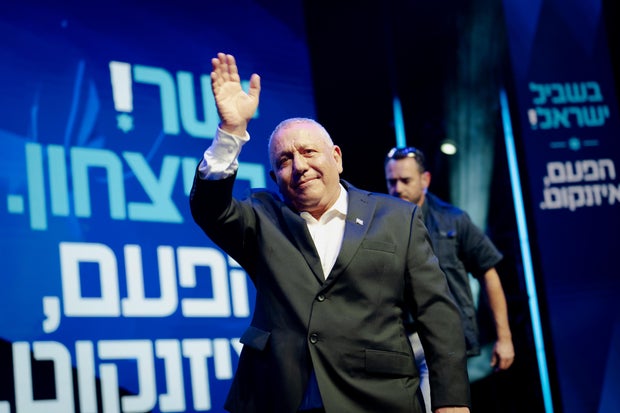
Israel’s parliamentary election produced a fragmented Knesset. The Likud-led bloc headed by Prime Minister Benjamin Netanyahu was projected to win 53 seats, while the opposition bloc led by former IDF chief Gadi Eisenkot’s Yashar party was projected at 48 seats. Both blocs fell short of the 61 seats required for an outright majority in the 120-member Knesset. Arab parties secured a record-breaking combined total of 19 seats, with the Joint List projected at 12 seats and Ra’am at seven seats. The Religious Zionist Party, United Torah Judaism, Shas and Otzma Yehudit together were expected to hold seven seats, and the Religious Zionist Party six seats.
Watch
Related reporting
cbsnews
Video: Israel's election results are unclear. Here's what comes next.
02
Political Stalemate and Coalition Prospects
Because no bloc can command a majority, President Isaac Herzog must consult party leaders to assign the task of forming a government. The appointed leader receives 28 days to negotiate a coalition, with a possible 14-day extension. If the first attempt fails, a second candidate may be named, restarting the 28-day clock without further extensions. Failure to assemble a coalition would trigger the dissolution of the Knesset and a new election.
Visual evidence
Images from the story


03
Strategic Context: Iran Threat and U.S. Influence
The election occurs against a backdrop of ongoing regional wars and a contested policy toward Iran. Lt. Gen. Eyal Zamir, IDF chief of staff, has indicated willingness to strike Iran only if Tehran’s “threat capabilities” recover rapidly or if a coordinated strategy could extract nuclear concessions. Zamir opposes an attack before elections, fearing a retaliatory Iranian missile strike could influence voting.
U.S. President Donald Trump has repeatedly signaled a desire to resume strikes on Iran after the U.S. midterm elections, and backing for an Israeli offensive could increase once the midterms conclude.
04
Official Statements & Responses
President Herzog urged all political leaders to keep “an open mind” and avoid another election, emphasizing the need for swift coalition talks. Trump, speaking beside Air Force One on October 28 2026, reiterated his support for Israel’s involvement in any renewed Iran operation. Zamir has publicly stated that any Israeli strike must be part of a “well-thought-out and considered strategy” and not jeopardize the upcoming elections.
05
Data & Statistics
- Likud bloc: 53 seats (Netanyahu)
- Yashar bloc: 48 seats (Eisenkot)
- Arab parties: 19 seats (Joint List 12, Ra’am 7)
- Ultra-Orthodox and nationalist partners: 7 + 6 seats (United Torah Judaism, Shas, Otzma Yehudit, Religious Zionist Party)
06
Conflicting Reports & Gaps
Sources differ on Trump’s post-midterm posture. These discrepancies highlight uncertainty about the timing and likelihood of an Israeli-Iranian confrontation.
07
What’s Next
President Herzog is scheduled to meet party leaders within the next week to determine the first coalition-building candidate. The appointed negotiator will have up to 28 days, with a possible 14-day extension, to forge a governing alliance. If negotiations stall, a second candidate may be appointed, and failing that, a new election could be called for early next year. The timing of any U.S. decision on Iran-related military action remains tied to the outcome of the U.S. midterm elections.