
Full Breakdown
Trump’s Comments on Canadian Politics Amid Ongoing U.S.–Canada Trade Tensions
By Drooid · · How we work
In this breakdown
01
Core Event: Trump Praises Provincial Wins and Predicts Quick Trade Settlement
President Donald Trump used his Truth Social platform and a Michigan rally to congratulate Quebec separatist leader Paul St-Pierre Plamondon and British Columbia premier-designate Lorne Doerkson on their election victories. Canadian Prime Minister Mark Carney said any progress in trade talks was because Washington was moving closer to Ottawa’s position, not because Canada had conceded.
Watch
Related reporting
ex
Donald Trump defends Canada trade war: 'They're not a state'
02
Background & Context
The dispute began after an August collapse of negotiations that had seemed close to a framework. The United States imposed 50 % tariffs on roughly $20 billion of Canadian goods; Canada responded with equivalent measures. The tariffs have become a focal point of the upcoming U.S. midterm elections, with candidates in Michigan and Maine citing the dispute in ads. The North American trade agreement (CUSMA) is slated for a review after a July 1 milestone, a process that could extend negotiations into 2027. Canada is also pursuing diversification, aiming to double non-U.S. exports within a decade and courting the European Union.
Visual evidence
Images from the story
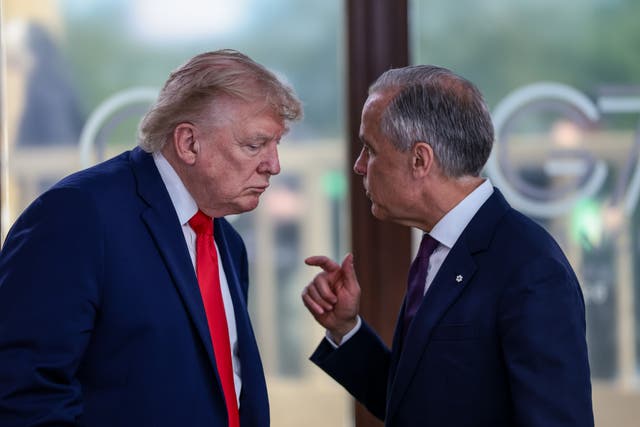


03
Data & Statistics
- 50 % tariffs affect about $20 billion of Canadian exports.
- The United States purchases millions of barrels of Canadian oil daily, typically at a discount.
- When energy is excluded, the U.S. runs a trade surplus with Canada; overall, the U.S. accounts for roughly 70 % of Canadian exports, down from 76 % a year earlier.
- Canada’s auto sector represents about 0.7 % of GDP.
- Carney’s diversification goal: double exports outside the United States over the next ten years.
04
Official Statements & Responses
Carney told reporters that any forward movement reflects Washington edging toward Ottawa’s demands and that his government remains in “constructive dialogue” with the United States. He reiterated that Canada’s negotiating position and red lines have not shifted since the August breakdown. The U.S. Embassy in Ottawa accused Canadian officials of seeking to influence the U.S. midterms; Carney rejected those allegations as having “no merit” and expressed disappointment with U.S. Ambassador Pete Hoekstra.
05
Criticism & Opposition
Political scientists Daniel Béland and Nelson Wiseman argued that Trump’s interference in provincial politics is misplaced and may boost Carney’s popularity. Wiseman noted that Doerkson, the new British Columbia premier, has publicly criticized Trump’s tariffs and labeled the president a “bully.” Trade expert Ed Fast warned that renegotiating within the narrow confines of CUSMA would leave Canada with little bargaining power and likely produce a one-sided outcome favoring the United States.
06
Conflicting Reports & Gaps
Trump’s statements assert that a settlement is imminent and that Canada is ready to concede, while Carney emphasizes that only the United States appears to be moving toward Ottawa’s demands and that no new Canadian offer exists. Sources close to the negotiations say “key elements” remain unresolved, and a CBC source confirmed that the talks have not reached the verge of an agreement. The disparity between the president’s optimism and Ottawa’s cautious stance highlights a gap in publicly verifiable progress.
07
What’s Next
- The partial rollback of the 50 % tariffs is scheduled to take effect at the end of the month.
- The U.S. midterm elections will occur in November, with trade-war rhetoric featuring prominently in several races.
- A CUSMA review is set to commence after the July 1 deadline, potentially extending negotiations into 2027.
- Prime Minister Carney will host European Union leaders in Montreal later this week to discuss deeper economic and security cooperation.