
Full Breakdown
North Korea Fires Unidentified Projectile Amid Surge in Missile Tests
By Drooid · · How we work
In this breakdown
01
Core Event: Unidentified Projectile Launch on Oct. 29
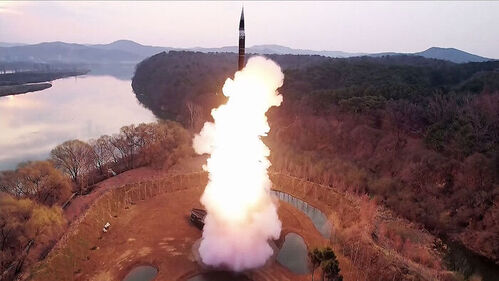
On Thursday, Oct. 29, North Korea fired an unidentified projectile toward the East Sea. South Korea’s Joint Chiefs of Staff said the military is analyzing its specifications, while Japan’s Ministry of Defense assessed it as likely a ballistic missile that has already fallen. If confirmed, it would be the first ballistic-missile test in 17 days, the previous one occurring on Oct. 12.
02
Background & Context
Tensions rose after September land-mine blasts injured three South Korean soldiers. Seoul blamed Pyongyang, which denied responsibility and warned of retaliation. The launch follows Kim Jong Un’s recent visit to China and reports of deeper North Korean-Russian military cooperation, including alleged Russian assistance with cruise-missile technology and submarine components. South Korean officials say Russian arms sales have generated more than $10 billion for North Korea, a sizable share of its $27 billion GDP.
Visual evidence
Images from the story


03
Timeline of Recent Missile Activity
- Sep. 20 – Test of an upgraded hypersonic Hwasong-11MA variant.
- Oct. 3 – Intermediate-range missile fired into the Sea of Japan; KCNA claimed a 1,000 km range, analysts said shorter.
- Oct. 12 – Ballistic missiles launched toward the East Sea, some exceeding 900 km.
- Oct. 14 – Test-firing of two submarine-launched cruise missiles, reportedly from the Hero Kim Kun Ok submarine.
- Oct. 29 – Unidentified projectile launched toward the East Sea.
04
Data & Statistics
- At least one missile on Oct. 12 traveled over 900 km.
- The Oct. 29 projectile could be a ballistic missile, pending verification.
- Russian-linked arms sales are estimated at over $10 billion, about 37 % of North Korea’s GDP.
- Three South Korean soldiers were injured in the September land-mine incidents.
05
Official Statements & Responses
- The JCS announced the Oct. 29 launch and is evaluating the projectile’s range and classification.
- Japan’s Ministry of Defense described it as “likely a ballistic missile” that presumably landed.
- KCNA later called the launch a test of a “tactical ballistic missile.”
- Kim Yo-jong said recent hypersonic missiles can maneuver at low altitude and incorporate AI to complicate interception.
- South Korea’s defence minister disclosed intelligence suggesting Russia may have supplied submarine nuclear-propulsion sets and other sensitive technologies.
- Seoul has proposed talks to clarify the inter-Korean borderline; North Korea has not responded.
06
Conflicting Reports & Gaps
- Classification of the Oct. 29 projectile remains unconfirmed; South Korean and Japanese officials treat it as probable ballistic, while North Korea labels it “tactical.”
- KCNA’s 1,000 km range claim for the Oct. 3 missile contrasts with allied assessments of a shorter reach.
- The operational status of the Hero Kim Kun Ok submarine as a launch platform is disputed.
07
Why It Matters
The launch adds to a rapid succession of tests that show expanding North Korean strike capabilities, including hypersonic and submarine-launched systems. If Russian technical assistance underpins these advances, it could accelerate North Korea’s ability to evade missile-defence systems and project power regionally, raising the risk of miscalculation along the heavily armed inter-Korean border.
08
What’s Next
South Korea has called for dialogue to prevent accidental clashes, but Pyongyang has not replied. Regional monitoring will continue, with the JCS and allied agencies tracking further launches and any evidence of foreign technical support.