
Full Breakdown
Jamia Millia Islamian Student Union Standoff Escalates
By Drooid · · How we work
In this breakdown
01
The Standoff Over a Student Union
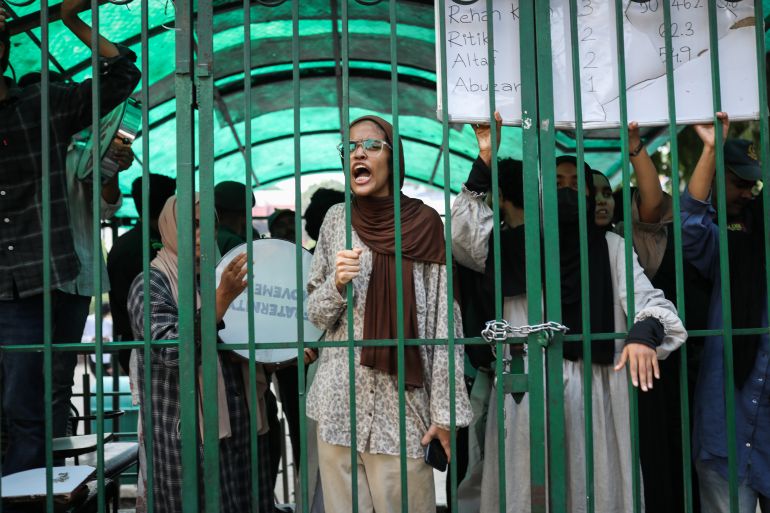
Students at Jamia Millia Islamia (JMI) in New Delhi have been protesting since October 12 for the restoration of a campus-wide students’ union that has been suspended for two decades. The university responded by suspending Basil for a year on October 16, barring two other hunger strikers, and sealing the main gates on October 24. Classes were shifted online and the campus placed under police and paramilitary presence.
Watch
Related reporting
brightcove
Protest at India university where no students’ union vote held for 20 years
02
Historical Context
Jamia Millia Islamia was founded in 1920 and attained federal university status in 1988. The first student-union election occurred in 1981, but elections were halted in 1997, briefly resumed in 2005, and dissolved again in 2006 after an alleged attack on the vice-chancellor. Subsequent attempts to revive the union—including a high-court petition in 2011 and a 2017 hunger strike—failed, leaving the university without an elected body for 20 years.
Visual evidence
Images from the story
03
Key Participants
- Ebin Basil – law student, hunger-strike leader.
- Mantasha Irfan – master’s student in peace and conflict studies, AISA member.
- M K Naush een Farook – second-year master’s student in disaster management.
- Saima Saeed – university spokesperson.
- Pralhad Joshi – Union Education Minister.
- Pawan Khera – Congress leader.
04
Timeline of Escalation
- October 12 – Basil begins hunger strike.
- October 16 – University suspends Basil for one year and bans two other strikers.
- October 17 – Nearly 200 protesters reconvene on campus.
- October 24 – Gates barricaded, classes moved online, students asked to vacate halls.
- December 20 – Deadline set for a committee to draft a union constitution; elections to follow within 15 days of approval.
- January 13 – Campus remains closed; online classes continue until this date.
- November 24 2026 – Online classes extended to this scheduled date.
- November 25 – later in December 2026 – Odd-semester examinations scheduled online.
05
Conditions on the Ground
Basil has lost 7 kg, reports low sodium and glucose, and says he can barely walk. Protesters describe severe shortages: only one functional toilet for hundreds, no water or electricity, and lack of sanitary pads for menstruating women. The campus is described as a “fortress” with armed personnel stationed at the gates.
06
Official Responses
University spokesperson Saima Saeed said the administration is the first in 20 years to accept the demand for a union and that the draft constitution will respect court orders, government recommendations, and university statutes. Union Education Minister Pralhad Joshi condemned alleged violence and warned that “hooliganism” would not be tolerated. Congress leader Pawan Khera denounced the closure as an “undeclared emergency,” asserting that students are exercising their constitutional right under Article 19(1)(c).
07
Student Criticism
M K Naush een Farook accused the administration of acting at the behest of the BJP and alleged pressure on women residents to leave their rooms. Mantasha Irfan highlighted the denial of basic supplies, noting that “Even women students who are menstruating do not have access to sanitary pads, and they are not allowing people to bring them in.” She linked the demand for a union to Jamia’s historic role in Muslim-community mobilization.
08
What Comes Next
The university has pledged to draft the union constitution by December 20 and to hold elections within 15 days of its approval. Students demand a written commitment that no disciplinary action will be taken against protesters. The academic calendar includes online odd-semester examinations from November 25 to later in December, with the winter break set for December 25 to January 12 2027 and the even-semester commencing on January 13 2027.