
Full Breakdown
Afghanistan’s Poppy Resurgence Threatens Farmers and Global Drug Markets
By Drooid · · How we work
In this breakdown
01
Surge in Cultivation Despite Ban
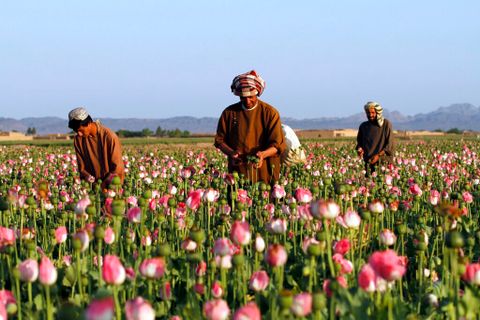
Satellite imagery analyzed by the United Nations Office on Drugs and Crime (UNODC) shows that poppy-cultivated area in Afghanistan more than quadrupled from 2025 to 2026, reaching an estimated 43,300 hectares—about a quarter of the 177,000 hectares planted in 2021, the year before the Taliban’s 2022 opium ban. The jump has revived concerns about a rebound in heroin supplies to Europe and Asia.
02
Background & Context
Afghanistan once supplied roughly 80 % of the world’s opium. After the Taliban seized power in August 2021, they imposed a formal ban on poppy cultivation in April 2022, citing religious grounds. The ban initially drove poppy fields nearly to zero, but pre-ban stockpiles cushioned global markets. Recurring drought, falling wheat revenues, and a two-thirds collapse in cotton prices have left legal crops unprofitable, prompting farmers to reconsider the ban. The first Taliban ban in 2000 collapsed after the September 11, 2001 attacks, underscoring the difficulty of sustaining prohibition without viable alternatives.
Visual evidence
Images from the story
03
Data & Statistics
- Cultivation area: 43,300 ha in 2026 (UNODC estimate) vs. 10,000 ha in 2025.
- Production: Estimated 1,500 metric tons, a 400 % rise from the previous year’s 300 tons.
- Revenue: Opium sales generated $525 million in 2026, the highest figure since 2018, excluding the price spike of 2022.
- Child malnutrition: UN agencies report critical malnutrition levels in 10 of 34 provinces, potentially rising to 14 by 2027.
- Livelihood gap: A UNODC survey found more than four-in-five households in Balkh and neighboring provinces replaced none or only part of lost poppy income.
04
On-the-Ground Reports
Mohammad Dawood, 28, of Baba Yusuf village in Balkh province, says he still obeys the ban but earns one-fortieth of his former poppy income, leaving his children malnourished. Landowner Gul Nazar, 56, describes briny well water from drought-shrunk rivers and notes that cotton prices have collapsed by about two-thirds after Pakistan closed its border late last year. At the Alam Khil health centre, nurse Salima Mohammadi observes a surge in severe malnutrition cases, attributing them to declining farm income rather than health-system failures.
05
Official Statements & Responses
The Taliban Interior Ministry declined comment on the UN figures, while the de facto authorities announced the eradication of 22,000 hectares of poppy this year.
06
Conflicting Reports & Gaps
The Taliban rejected UNODC’s estimate, claiming actual cultivation is about half the UN figure and asserting that eradication efforts continue. No independent verification of the Taliban’s lower estimate has been presented, leaving a gap between the UN’s satellite-based assessment and the government’s claim.
07
Verbatim Quotes
- “Combine this with the active trafficking networks within the country and the resilient smuggling operations to get the opiates out of the country, and you have a very bleak prediction for the future,” — Paddy Ginn, an analyst with the Geneva-based Global Initiative Against Transnational Organized Crime
- “An effective fight against this phenomenon is a shared responsibility of both Afghanistan and the international community,” — Amir Khan Muttaqi, foreign minister