
Full Breakdown
NASA and Canadian Astronauts Complete 100th U.S. Spacewalk to Boost ISS Power
By Drooid · · How we work
In this breakdown
01
The 100th U.S. Spacewalk: Installing the Seventh iROSA
On October 29, 2026, NASA astronaut Anil Menon and CSA astronaut Joshua Kutryk exited the Quest airlock at 8 a.m. EDT for a six-hour-45-minute EVA that installed the seventh International Space Station Roll-Out Solar Array (iROSA) on the port-side truss. Menon operated Canadarm2 while Kutryk moved hand-over-hand to the installation site. The pair will return on November 5 for a second EVA to place the eighth iROSA.
02
Background & Context
The ISS’s original solar-array wings, launched between 2000 and 2009, were designed for a 15-year lifespan and have degraded after more than two decades. Beginning in 2021, NASA added compact, high-efficiency iROSA panels in front of the legacy wings. The latest two arrived on a SpaceX CRS-35 cargo Dragon on October 13. The upgrade is intended to sustain station operations through its planned deorbit after 2030.
Canada’s involvement includes CSA astronaut Jenni Gibbons serving as capsule communicator and the use of Canadarm2, which positioned the folded arrays on the station’s mobile base. Kutryk’s EVA marks the first Canadian spacewalk in seven years and the fifth Canadian astronaut to walk in space.
Visual evidence
Images from the story




03
Data & Statistics
- Power capacity: from 160 kW to about 215 kW, roughly a 30 % increase (NASA).
- Total iROSA panels: eight; six already installed, two remaining.
- Each iROSA: 750 lb (? 340 kg) on Earth, about 10 ft (3 m) folded, extending to roughly 20 ft (6 m) when deployed.
- EVA count: the October 29 walk is the 285th ISS assembly-related EVA and the 100th conducted by a U.S. astronaut from Quest without a shuttle.
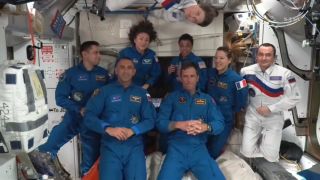
- Crew support: flight engineers Jessica Watkins and Luke Delaney operated Canadarm2 from inside the station.
04
Official Statements & Responses
Operations integration manager Gaurang Patel said the additional power will sustain life-support, research and commercial activities. Flight director Garrett Hehn noted that rotating the arm around the array’s center of mass reduced astronaut fatigue. CSA capcom Jenni Gibbons highlighted the collaborative nature of the operation.
05
Verbatim Quotes
- “We can't have any sun on the arrays, whenever we're handling those hot cables,” — Garrett Hehn
- “It even loosened bolts for us before the spacewalks … I'm grateful for the help,” — Anil Menon
- “Overall, these roll-out arrays increase our power generation capability up to 30 percent,” — Gaurang Patel
06
On-the-Ground Reports
Inside the ISS, astronauts Jessica Watkins and Luke Delaney wished the spacewalkers good luck before sealing the Quest hatch. NASA flight controllers monitored suit pressures and thermal conditions throughout the EVA, confirming that all systems remained nominal. Menon later described the preparation as “busy” and thanked Canadarm2 for loosening bolts ahead of the walk.
07
What’s Next
The follow-up EVA on November 5 will install the eighth iROSA on the starboard side of the truss, requiring a “leapfrog” maneuver beyond Canadarm2’s reach. Completion of both walks will finalize the iROSA upgrade, securing the ISS’s power supply for its remaining operational years.