
Full Breakdown
Supreme Court Flags Worsening Delhi Air Quality After Diwali
By Drooid · · How we work
In this breakdown
01
Core Event: Court Hearing Highlights Post-Diwali Smog
During a hearing on a pollution-linked petition, Justice Vikram Nath warned that “Post Diwali, the air in Delhi will be very bad.” Senior advocate Indira Jaising asked that the matter be listed for November 17, noting that Delhi’s air is “extremely polluted” around the festival. Justice Nath replied that judges cannot work from home and must appear in court despite the anticipated deterioration. The bench offered a November 3 date, emphasizing that the environment would be cleaner before Diwali and markedly worse afterward.
02
Background & Context: Evolving Firecracker Restrictions
The Supreme Court has issued directions on Delhi-NCR air-pollution sources, including vehicular emissions, industrial output, stubble burning and firecrackers. In December 2024 the Delhi government reported a comprehensive ban on firecrackers covering manufacture, storage, sale, distribution and use. Subsequent orders extended the ban to Uttar Pradesh, Rajasthan and Haryana (January 2025) and required enforcement under the Environment (Protection) Act, 1986 (May 2025).
A bench led by Chief Justice B.R. Gavai relaxed the prohibition on October 15 2025, permitting approved green crackers for limited hours on October 19-20, while prohibiting barium-containing and unapproved products. A bench of Justices M.M. Sundresh and Prasanna B. Varale (October 29 2024) reiterated that the Court is not inclined to impose a total ban but warned that annual orders are ineffective without on-ground enforcement.
Visual evidence
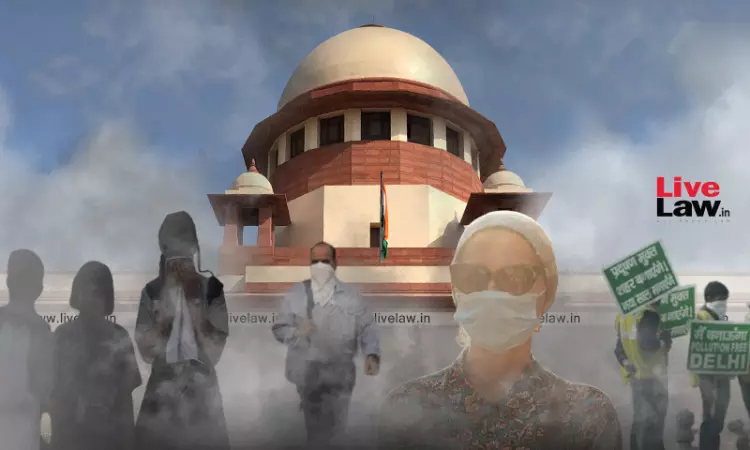
Images from the story
03
Data & Statistics: Air Quality Index (AQI) Spikes Around Diwali
- October 18 2025: 24-hour average AQI 268
- October 19 2025: AQI 296
- Diwali (October 20 2025): AQI 345 (very poor)
- October 21 2025: AQI 351
- October 22 2025: AQI 353 (very poor)
In 2026, the Commission for Air Quality Management invoked Stage I of the Graded Response Action Plan on October 21 2026 after the daily average AQI reached 244 (2 pm) and 245 (4 pm). Subsequent readings were 197 (4 pm, October 27 2026).
04
Official Statements & Responses
- Justice M.M. Sundresh stated, “We make it very clear. Neither we are going to agree with you for total ban. Nor are we going to allow them to do it 24 hours,” emphasizing a balanced approach that respects religious sentiments while protecting health.
- The Chief Justice of India asked, “What does religion have to do with firecrackers?” highlighting judicial scrutiny of the cultural rationale for fireworks.
- Additional Solicitor General Aishwarya Bhati briefed the bench on Delhi’s anti-pollution plan: vehicles lacking BS-VI standards will be barred from entering the capital from November 1; staggered office timings, deployment of 608 anti-smog guns, and the Vayu Rakshak initiative are in place.
05
Why It Matters: Health and Enforcement Implications
An amicus curiae cited a study estimating that Delhi residents lose 4.7 years of life expectancy due to PM2.5 exposure. Chest surgeons reported increasing cases of black deposits in lungs of non-smoking children and adolescents, and a shift from 90 % of lung-cancer patients being smokers in the 1980s to roughly 50 % now being non-smokers. The amicus also noted that “green crackers” reduce emissions by only about 30 %, questioning their efficacy as a mitigation tool.