
Full Breakdown
Sydney Southwest Metro Extension Opens After Two-Year Delay
By Drooid · · How we work
In this breakdown
01
First Driverless Service Launched
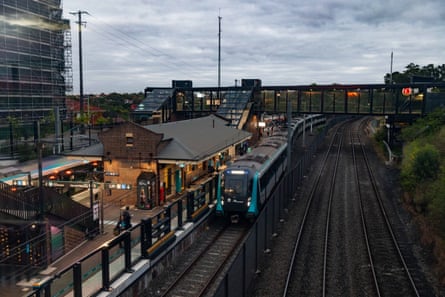
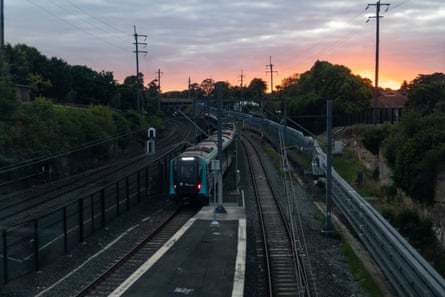
A driverless six-car metro train departed Bankstown in the early hours of a Friday, completing the 13-kilometre southwest stretch and joining the existing line to Tallawong for a continuous 66 km corridor. The inaugural service ran at 4:31 a.m., arriving at Sydenham after roughly 20 minutes and then proceeding north-west to Tallawong. The opening ends more than two years of replacement “pink” buses that ran while the former T3 heavy-rail line was converted.
02
Project History and Rationale
The conversion of the 130-year-old T3 Bankstown line to a driverless rapid-transit system was announced in 2014. Initial estimates projected a 12-month construction period and a total cost of about A$11.5 billion. By opening, the combined cost of the southwest and north-west sections had risen to just under A$23 billion, roughly double the original forecast. The project survived cancellation threats in the 2019 and 2022 elections and was retained by the Minns Labor government, which added A$1.1 billion in 2023.
Visual evidence
Images from the story


03
Key Figures and Performance Data
- Line length: 66 km continuous driverless network.
- Train capacity: 1,100 passengers per six-car set.
- Peak-hour capacity: 17,000 passengers.
- Journey-time improvements: Bankstown -> Central reduced to 28 minutes (6-minute saving); Lakemba -> Victoria Cross now 37 minutes (24-minute saving).
- Construction cost: just under A$23 billion, with A$10 billion allocated to the southwest segment.
04
Government and Agency Responses
Transport Minister John Graham said signage along the new route is clear to avoid passenger confusion. Member for Bankstown Jihad Dib described the service as a “massive difference” for local residents and noted community enthusiasm at the opening ceremony. The NSW government reported that the new line will increase capacity by 50 percent compared with the old T3 service.
05
Commuter Experiences on Opening Day
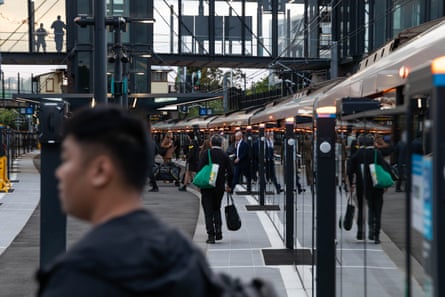
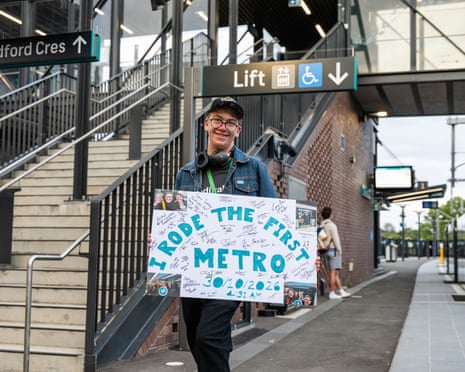
Parents and school-age children expressed relief at the end of the bus era. Ms Das, a Bankstown-to-Pyrmont commuter, said her travel time would be cut by half an hour, while Mr Sharma from Campsie noted the commute had already dropped to 20 minutes. Young rail enthusiast Angus—who missed the 2024 opening—celebrated finally riding the new service.
06
Discrepancies in Reported Figures
Sources differ on the total project cost: the Guardian and ABC cite “just under A$23 billion,” whereas SMH references an earlier forecast of A$21.6 billion and later a figure of A$23 billion after additional funding. The projected peak-hour capacity is consistently reported as 17,000 passengers, but the exact percentage increase over the former heavy-rail line varies between “50 percent” and “50 percent”.
07
Verbatim Quotes
- “My start of school was at 8 o’clock and I couldn’t go to that [2024] opening,” — Angus, 14, rail enthusiast
- “It's clearly signposted so there's going to be no confusion,” — Transport Minister John Graham
- “I checked the schedule, and it's probably going to cut me half an hour," Ms Das said.” — Ms Das, commuter
- “I can see the commute time is already all the way down to 20 minutes," Mr Sharma said.” — Mr Sharma, commuter