
Full Breakdown
Binance Suspected Hack Triggers Massive Outflows and Market Turmoil
By Drooid · · How we work
In this breakdown
01
The Core Event
On October 29, 2026 large outflows began from Binance’s Ethereum hot wallets at ~20:24 UTC. The first transaction, “Binance 14” on Etherscan, moved 167,464 ETH and about 1.6 billion USDT to a new address. A second wallet (“Binance 16”) sent 28,000 ETH seconds later, and a third hot wallet transferred roughly 780 million USDC. In total, on-chain data show between $2.4 billion and $5.8 billion leaving Binance-controlled addresses across multiple blockchains. The outflows were initiated by a contract delegated via EIP-7702 (live since the May 7 2025 Pectra upgrade). The delegating address received gas funds from the mixer Tornado Cash.
02
Background & Context
Hot wallets—online accounts used by exchanges to process withdrawals—are frequent targets because they hold billions in liquid assets. Binance suffered a hot-wallet breach in 2022; similar attacks hit Bybit (2025) and Bitget (2026). The October 2026 incident would surpass the $1.5 billion Bybit hack, making it the largest crypto theft on record.
Visual evidence
Images from the story







03
Data & Statistics
- Ethereum outflows: ? 167,464 ETH (~$388 M) + ? 1.6 B USDT.
- Additional transfers: ? 28,000 ETH and ? 780 M USDC.
- Estimated loss: $2.4 B (Yahoo Finance) to $5.8 B (various analysts).
- Stablecoin freezes: Tether froze > $1.567 B USDT; Circle froze > $800 M USDC, together locking about $2.4 B.
- Unfrozen assets: roughly 195,460 ETH (? $440 M) remain in attacker-controlled addresses.
- Market impact: Bitcoin slipped below $79,000 (~3%); BNB dropped up to 9% before partially recovering; leveraged positions worth ? $628 M were liquidated within an hour.
04
Official Statements & Responses
- Binance warned users to avoid scams and said updates would come only through official channels.
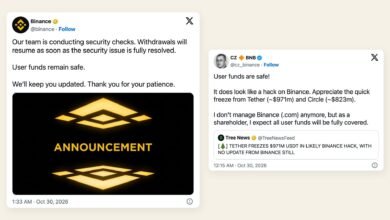
- Changpeng Zhao (founder, former CEO): Called the activity a hack and said “user funds are safe,” adding he expects full coverage for users.
- Yi He (co-founder): Said the firm has not confirmed any impact to user funds and that security teams are reviewing information urgently.
- Paolo Ardoino (Tether CEO): Stressed the priority to protect the industry and noted the freeze of more than $1.567 B USDT.
- Jeremy Allaire (Circle CEO): Reported freezing over $800 M USDC in coordination with law enforcement.
- World Liberty Financial: Announced a proactive freeze of $27 M linked to the incident and pledged cooperation with investigators.
05
Conflicting Reports & Gaps
Estimates of the total outflow vary: some analysts cite $2.4 B, others $5.7 B based on data across Ethereum, Arbitrum, and Avalanche. The exact amount of ETH that remains unfrozen and the attacker’s identity are unknown. Binance has not disclosed whether its Secure Asset Fund for Users (? $1 B) will be tapped, nor confirmed the precise loss figure.
06
Why It Matters
The incident underscores systemic risks in centralized exchanges: hot-wallet exposure, reliance on a single private key, and limited ability of stablecoin issuers to freeze non-stablecoin assets such as ETH. Coordination by Tether and Circle limited immediate liquidity for the attacker, but unfrozen ETH and other tokens could still be sold on decentralized markets, pressuring broader cryptocurrency prices.
07
What’s Next
Binance will provide updates through official channels, but no timeline for a final loss assessment or for resuming full withdrawals has been announced. Regulators and law-enforcement agencies are monitoring the case, and the crypto community awaits clarification on whether the Secure Asset Fund for Users will be used to reimburse affected customers.