
Full Breakdown
Egypt Authorises Defensive Military Support for Saudi Arabia Amid Heightened Houthi Attacks
By Drooid · · How we work
In this breakdown
01
Core Decision and Immediate Reaction
On Monday, Egypt’s House of Representatives voted in a closed session to grant President Abdel Fattah el-Sisi authority to provide “defensive military support” to Saudi Arabia if Riyadh requests assistance against the Iran-backed Houthi rebels. The measure passed with the required two-thirds majority, though the exact tally was not released. The authorization covers air-defence systems and aircraft but does not include ground troops in Yemen, according to a regional official briefed by the Associated Press.
The Houthi political bureau responded the same day. Mohammed Ali al-Houthi posted on Telegram:
- “It is truly remarkable that while these people go to discuss what they call ‘peace in the region,’ Egypt and its parliament declare support for the so-called defense of the Kingdom of Saudi Arabia, and in doing so, declare war against the Republic of Yemen.”
He framed Egypt’s move as a “declaration of war” against Yemen.
Watch
Related reporting
youtube
LIVE: Israel's election results
brightcove
Fighting rages near Yemen’s Taiz as UN urges humanitarian access
02
Background & Context
The Saudi-led coalition has fought the Houthi movement since the rebels seized Sanaa in 2014. Egypt joined the coalition in 2015, contributing naval assets and about 800 troops, but has avoided large-scale ground deployments. Recent Houthi escalations—missile and drone strikes on Saudi oil facilities, airports and the Bab el-Mandeb Strait—have revived regional security concerns. Saudi Arabia remains Egypt’s principal financial backer, holding roughly $10.3 billion in deposits at the Egyptian central bank and providing billions in aid and remittances.
Visual evidence
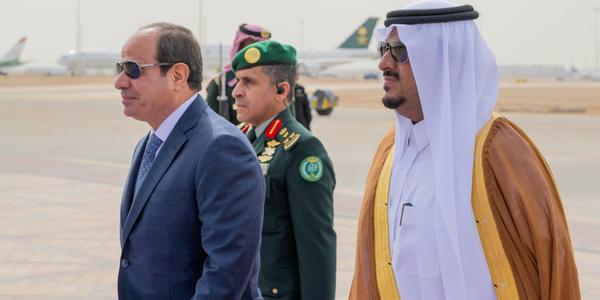
Images from the story


03
Official Statements & Responses
- President el-Sisi reiterated that any Egyptian role would be limited to defending Saudi territory and holy sites, explicitly ruling out offensive operations in Yemen.
- Saudi Defence Minister Khalid bin Salman, accompanied by Pakistan’s army chief Asim Munir and Turkey’s intelligence chief Ibrahim Kalin, met Iranian officials in Tehran to discuss de-escalation.
- A senior Egyptian diplomatic source told Al Manassa that Cairo has conveyed “political settlement” messages to all parties and is maintaining “de-escalation efforts”.
04
Criticism & Opposition
Yemen’s Houthi movement condemned the decision, saying any military participation alongside Saudi Arabia, even if defensive, amounts to joining the war on Yemen.
Domestically, the Egyptian Social Democratic Party abstained, citing insufficient information on mission scope, duration and cost, and urging a diplomatic focus.
05
On-the-Ground Reports
The intensified fighting around Taiz has deepened the humanitarian crisis. Residents report that road closures since 4 Oct 2026 have cut off the main supply artery, driving food and fuel prices up four-fold. In a Red Cross-run field hospital, a 55-year-old patient, Fatima, described living in a hospital hall because she cannot afford transport to a distant clinic.
- “I feel like I am imprisoned here. We have no housing or shelter here. This hall is our shelter.”
06
Conflicting Reports & Gaps
- The parliamentary statement did not specify the type of equipment Egypt would provide; a Reuters-cited regional official said air-defence systems and aircraft are likely, while other sources note the lack of a formal Saudi request.
- Saudi authorities have not confirmed Houthi claims of attacks on the East-West oil pipeline and Riyadh’s airport on the day of the Egyptian vote.
07
What’s Next
The authorization removes Egypt’s final domestic legal hurdle. Deployment now hinges on a formal request from Saudi Arabia, which has not yet been made. Egypt’s foreign minister says diplomatic channels remain open to seek a political settlement, while regional defence talks involving Saudi Arabia, Pakistan and Turkey continue in Tehran.