
Full Breakdown
Houthi Missile and Drone Strikes Prompt Saudi Defense Measures and Egyptian Parliamentary Backing
By Drooid · · How we work
In this breakdown
01
Recent Wave of Attacks on Saudi Targets
In early October 2026 the Iran-aligned Houthi movement announced six coordinated attacks on Saudi Arabia, targeting the Ras Tanura and Rabigh refineries, the Abqaiq Aramco facility, and the airports in Riyadh and Dammam. Saudi civil-defence alerts covered Riyadh, the Eastern Province, Najran and Kharj. Intercepted ballistic missiles over Riyadh on 30 October produced falling debris that injured one civilian and damaged a house and a vehicle. Coalition spokesman Turki al-Maliki said two missiles were destroyed, and the coalition also reported intercepting three missiles toward the Eastern Region and four drones toward the Southern Region that day.
Watch
Related reporting
brightcove
Officials from Mecca pact states to hold talks in Iran amid regional tensions
02
Diplomatic Context and Regional Talks
The attacks came after a high-level meeting in Tehran that included senior officials from Iran, Saudi Arabia, Turkey and Pakistan. Hosted by Iran’s security chief Mohsen Rezaei, the talks featured Saudi Defence Minister Prince Khalid bin Salman, Pakistan’s army chief Field Marshal Asim Munir and Turkish intelligence chief Ibrahim Kalin. An Iranian press release said participants agreed to continue discussions on “peace and security” in the region. Saudi foreign-ministry statements emphasized opening negotiation channels to prevent further escalation.
Visual evidence
Images from the story




03
Egypt’s Parliamentary Authorization
On 26 October 2026 Egypt’s House of Representatives passed a two-thirds-majority vote authorising President Abdel-Fattah el-Sisi to provide military assistance to Saudi Arabia if requested. The decree allows Egypt to take “necessary measures” to protect Saudi territory, sovereignty and holy sites, limited to air-defence systems and aircraft, with no ground-troop deployment. President el-Sisi stressed that any Egyptian role would be defensive only.
Opposition within Egypt
The Social Democratic Party instructed its MPs to abstain, citing insufficient information about the mission’s scope, duration, cost or risks. Houthi parliament speaker Yahya al-Raei warned on 17 October that Egyptian involvement would amount to a “declaration of war” on Yemen and jeopardise Egypt’s security.
04
Impact on Oil Exports and Markets
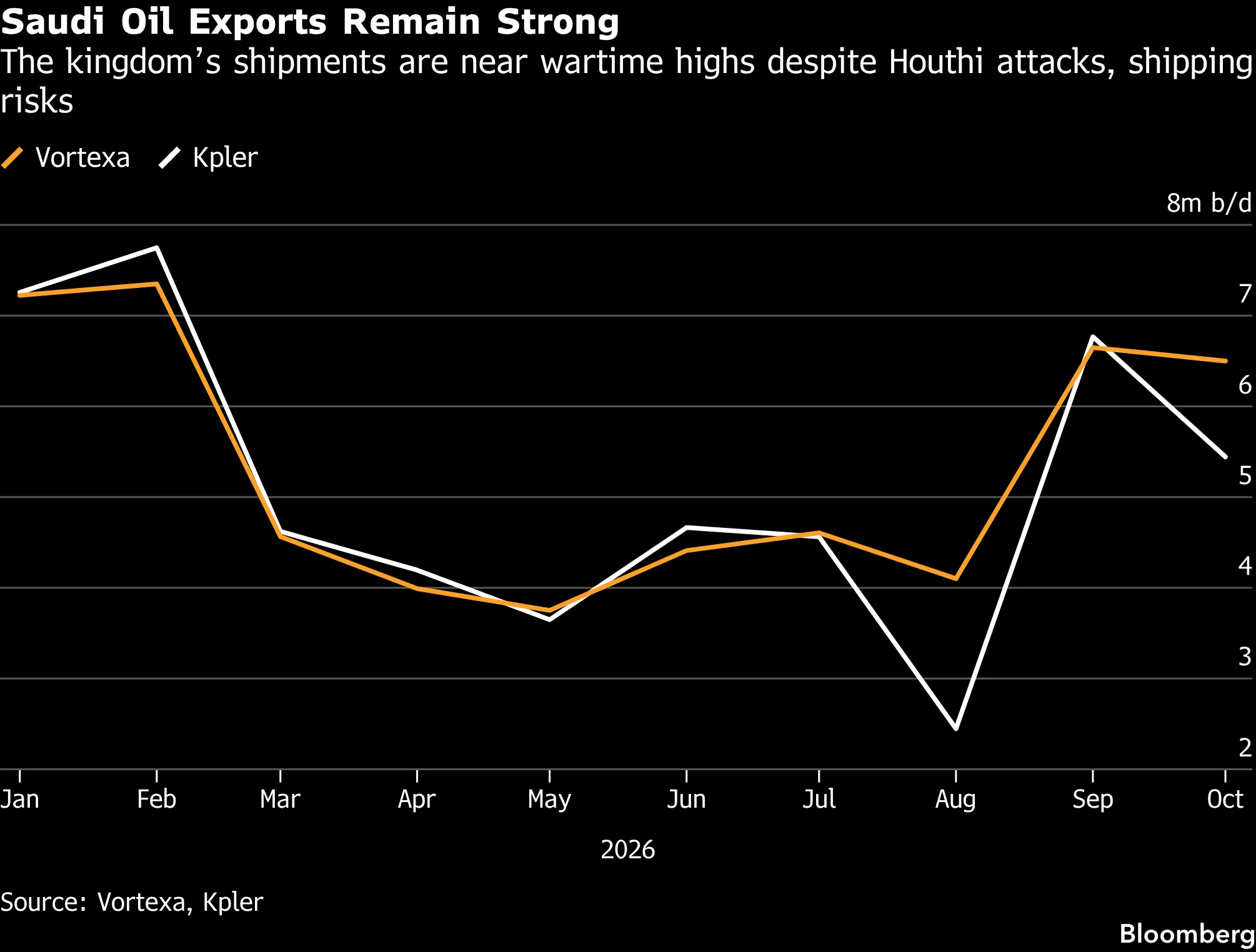
Despite the attacks, Saudi oil shipments remained near wartime levels. Ship-tracking firm Vortexa reported an average export of 6.5 million barrels per day in October, comparable with the previous month. Bloomberg data showed Red Sea exports from Yanbu at 2.5 million barrels per day, up from 2.4 million in September, while Gulf-wide exports fell to about 4 million barrels per day. Brent crude futures traded around $115.70 a barrel and WTI around $101.20 in early Asian trade, up roughly 1.5 % on the session. The American Petroleum Institute estimated a crude-inventory draw of 2.03 million barrels for the week ending 23 October.
05
Official Statements & Responses
Saudi Civil Defence issued early-warning alerts and confirmed that missile debris caused minor injuries and property damage in Riyadh on 30 October. The Saudi foreign ministry reiterated its commitment to diplomatic engagement following the Tehran meeting. Houthi spokesperson Yahya Saree asserted that the group’s missiles and drones had struck the intended commercial and military infrastructure.
06
Conflicting Reports & Gaps
Independent verification of several Houthi claims—such as damage to the Ras Tanura refinery and the East-West pipeline—has not been provided by Saudi authorities. Export figures differ among tracking firms: Vortexa cites 6.5 million barrels per day, Kpler estimates 5.4 million, and Tankertrackers suggests 6.99 million. These discrepancies highlight limited visibility caused by tankers switching off satellite transponders.