
Full Breakdown
Netanyahu’s bloc leads but falls short of a majority in Israel’s 2026 election
By Drooid · · How we work
In this breakdown
01
Core Event: Election deadlock and the hunt for a governing coalition
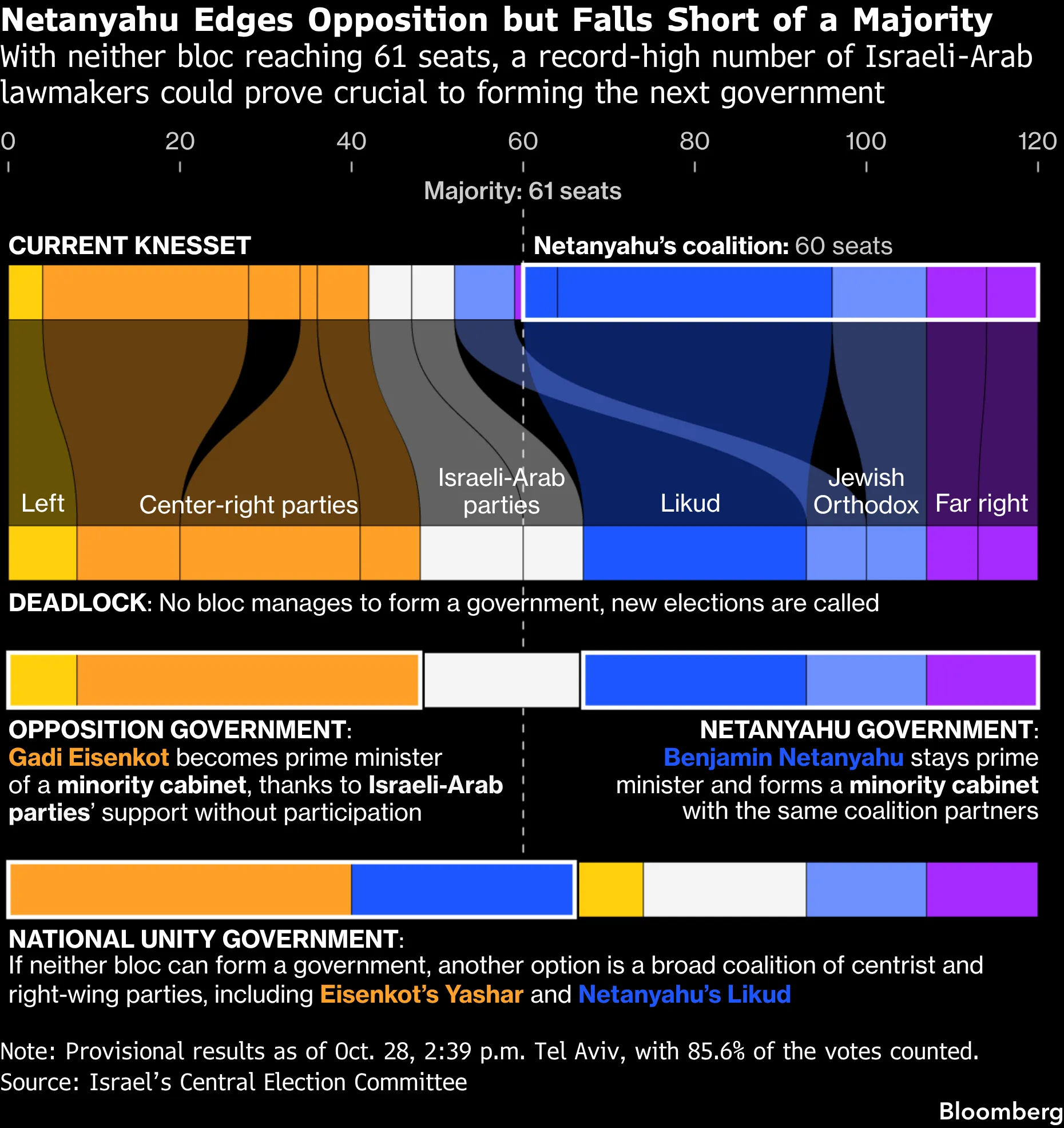
The Oct 27, 2026 election produced a fragmented Knesset. The Likud-aligned bloc secured 53 seats, while the opposition bloc led by former IDF chief Gadi Eisenkot won 48. Neither reached the 61-seat majority. Arab parties—the Joint List and Ra’am—combined for a record 19 seats, making them potential kingmakers.
02
Background & Context: Rising Arab turnout and allegations of foreign influence
Arab voter participation doubled, expanding Arab parties’ parliamentary presence. Likud accused the Arab parties of “stealing” the election through alleged bribery, intimidation and software-driven voter mobilisation. The Central Elections Committee (CEC) tasked Shin Bet with probing possible foreign funding, naming Qatar and Turkey as suspected sources.
Visual evidence
Images from the story



03
Timeline
- Oct 25 – CEC’s acting director-general contacts all electoral lists about integrity monitoring.
- Oct 27 – Election day.
- Oct 28 – Preliminary seat tallies released; both blocs fall short of a majority.
- Nov 4 – Deadline for full count and official certification.
- Nov 10 – Deadline for swearing-in of the new Knesset.
04
Data & Statistics
- Total Knesset seats: 120.
- Likud-aligned bloc: 53 seats (Likud 27, UTJ 7, Otzma Yehudit 7, Religious Zionist 6, Shas 6).
- Opposition bloc: 48 seats (Yashar 21, B’Yachad 12, Democrats 8, Beytenu 7).
- Arab parties: Joint List ? 11-12 seats; Ra’am ? 7-8 seats; total 19.
- Small right-wing parties failed to meet the 3.25 % threshold.
05
Official Statements & Responses
Netanyahu’s Likud demanded police and Shin Bet investigate “theft of the elections” by Arab parties. The CEC confirmed receipt of the submission and directed Shin Bet to pursue the probe.
Eisenkot denounced the allegations as a coordinated campaign to delegitimize the vote and warned against delaying the Knesset’s swearing-in.
Qatar’s foreign ministry denied any interference. Ra’am chair Mansour Abbas welcomed the CEC investigation but said his party had no foreign funding.
President Isaac Herzog called on all parties to keep “an open mind” and urged swift coalition talks.
06
Criticism & Opposition
Police described election day as having only a “small number of unusual incidents” compared with previous contests.
Avigdor Liberman of Israel Beytenu reiterated his refusal to sit with Arab parties or with Netanyahu, insisting on a “Zionist-only” coalition.
07
Conflicting Reports & Gaps
- Allegations vs. evidence: Likud’s accusations (cash-filled envelopes, duplicate identities, prohibited software) remain unverified; police and independent observers have found no substantive proof.
- Seat projections: Exit polls varied (Kan and Channel 13 projected 51-52 seats for each bloc; Channel 12 suggested 52 for Likud). The final certified count is pending as of the Nov 4 deadline.
08
What’s Next: Coalition talks and possible extensions
President Herzog will meet party leaders within the next week to assign the first mandate to form a government. The designated candidate has 28 days to negotiate a coalition and may request a 14-day extension. If the first attempt fails, a second candidate may be appointed, resetting the 28-day clock. Should all attempts falter, the Knesset will be dissolved and a new election scheduled for early 2027.