
Full Breakdown
Supreme Court Appoints Former Judge Ranjana Prakash Desai as Mediator in Krishna Godavari (KG)-Basin Gas Dispute
By Drooid · · How we work
In this breakdown
01
Core Development
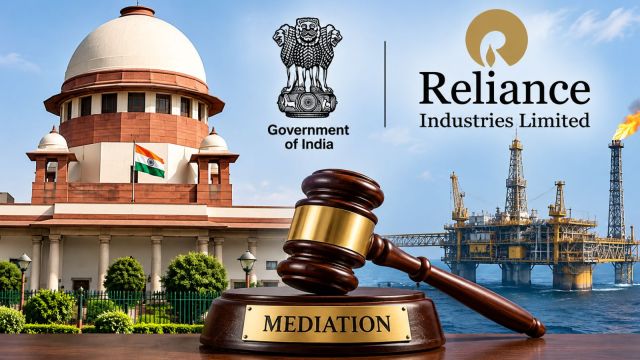
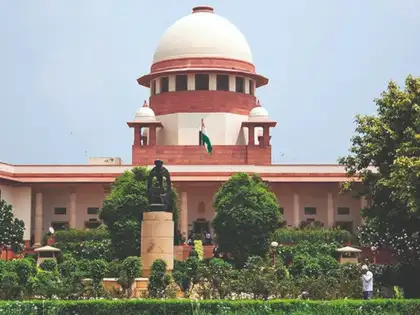
On October 30, 2026, a three-judge bench of the Supreme Court—Chief Justice Surya Kant, Justices Joymalya Bagchi and Vipul M Pancholi—appointed former Justice Ranjana Prakash Desai as the sole mediator to resolve the gas-migration dispute in the Krishna-Godavari basin. Attorney General R Venkataramani, appearing for the Union Government, pledged full cooperation.
02
Background & Context
The dispute stems from a 2000 Production Sharing Contract (PSC) between the Union Government and a consortium led by Reliance Industries Ltd (RIL), with BP Exploration (Alpha) Ltd (30 %) and Niko (NECO) Ltd (10 %). Commercial production from KG-D6 began in April 2009. In 2013, ONGC alleged that the consortium extracted gas migrating from ONGC’s adjoining offshore blocks, resulting in “unjust enrichment.”
Visual evidence
Images from the story
03
Timeline
- 2000 – PSC signed.
- April 2009 – Commercial production starts.
- 2013 – ONGC raises allegation of migrated gas extraction.
- Nov 2015 – Technical study (DeGolyer & MacNaughton) reports reservoir connectivity.
- 2016 – Government issues demand of roughly $1.55 billion plus interest.
- July 2018 – Arbitral tribunal rules 2-1 for RIL, awarding $8.3 million to partners.
- May 2024 – Delhi High Court upholds award.
- Feb 14 2025 – Division bench sets aside award, citing illegality and public-policy concerns.
- May 20 2026 – Supreme Court declines to pause hearing despite RIL’s mediation request.
- Oct 30 2026 – Justice Desai appointed mediator.
04
Data & Statistics
- Government claim (2016): ? $1.55 billion plus interest.
- Later notices cite $1.5 billion, $1.73 billion, and $2.81 billion.
- Arbitration award (2018): $8.3 million to the three partners.
05
Official Statements & Responses
- Attorney General R Venkataramani said the government will cooperate fully with the mediator.
- Senior Advocates Kapil Sibal and Abhishek Manu Singhvi supported appointing a mediator with expert assistance.
06
Verbatim Quotes
- “Settlements have not come through. There are two courses available: this court can decide the matter on merit or appoint a mediator to explore the possibility of settlement,” — Venkataramani
07
Conflicting Reports & Gaps
- Monetary claims vary: $1.5 billion, $1.55 billion, $1.73 billion, and $2.81 billion across different sources.
- Interest amounts are sometimes listed as $174 million and sometimes omitted.
- The arbitration award is consistently noted as set aside, though the precise legal reasoning differs among reports.
08
Why It Matters
The mediation marks a shift from litigation to negotiation in a dispute involving billions of dollars and the interpretation of India’s PSC framework. A settlement could clarify the legal treatment of gas migration in offshore reservoirs and influence future resource-sharing conflicts.
09
What’s Next
Justice Desai will schedule mediation sessions promptly, with parties expected to contact her within days. The bench will review progress after four weeks, though no fixed settlement deadline has been set.