
Full Breakdown
Alphabet’s AI Spending Spree Triggers Cash-Flow Crisis Amid Diverging Peer Strategies
By Drooid · · How we work
In this breakdown
01
Core Event
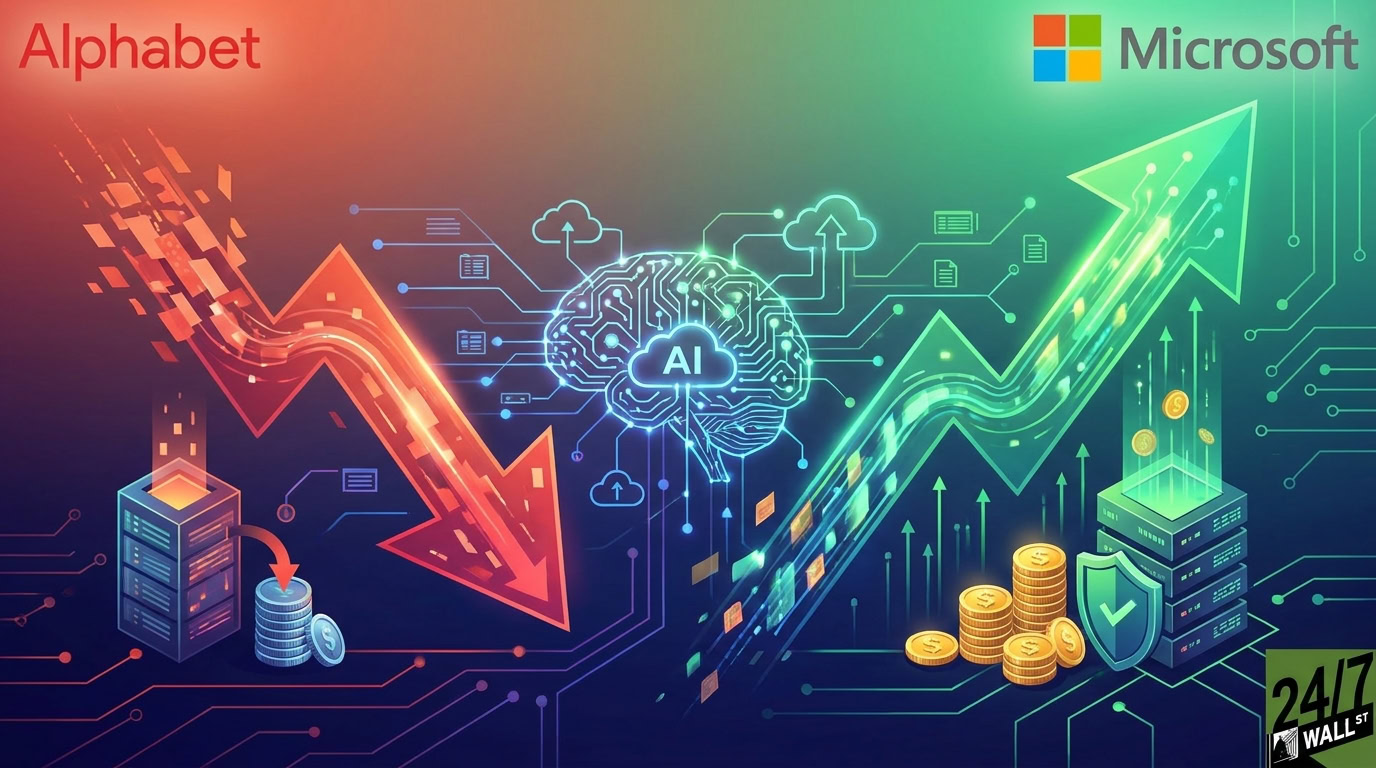
Alphabet (GOOGL) reported Q3 2026 results that missed expectations, posting revenue of $127.6 billion and a negative free-cash-flow (FCF) of $9.07 billion—the first quarterly FCF deficit in its 22-year public history. The stock fell more than 12%, erasing roughly $500 billion in market value (NBC News; CNN). Microsoft (MSFT) posted positive FCF of $18.6 billion while its AI-related capex stayed below forecasts.
02
Background & Context
The five hyperscalers—Alphabet, Microsoft, Amazon, Meta, and SpaceX—are racing to build the AI economy’s physical backbone. Their combined 2026 capex is projected between $803 billion and $828 billion. Alphabet expects $195 billion to $205 billion in capex for the year, with a “significant increase” slated for 2027. Microsoft announced a $25 billion bond offering to fund its AI infrastructure expansion.
Visual evidence
Images from the story
03
Data & Statistics
- Alphabet Q3 capex: $51.4 billion.
- Search revenue: $63.35 billion, up 12% YoY but below estimates.
- Google Cloud revenue: $30.71 billion, more than double YoY.
- Azure revenue: $33.2 billion, up 48% YoY.
- Microsoft capex: $45.2 billion, with a $170 billion full-year outlook.
- Meta Q3 capex: $135 billion-$145 billion.
- Amazon Q3 cash capex: $75.9 billion, the largest among peers.
04
Why It Matters / Impact
Investors are reassessing which AI spenders can turn massive outlays into sustainable revenue. Alphabet’s cash burn forced it to issue $28.7 billion in senior notes and raise $12.4 billion through at-the-market stock sales. The dividend remains $0.22 per share, a small fraction of operating cash flow, and buybacks have been suspended. Microsoft’s disciplined spending leaves ample cash to return to shareholders, reinforcing a narrative that financial prudence may outweigh sheer scale in the AI race.
05
Official Statements & Responses
06
Verbatim Quotes
07
Conflicting Reports & Gaps
Alphabet’s FCF deficit is reported as $9.07 billion by Reuters and $9.1 billion by CNBC, a rounding difference. Capex guidance for 2027 ranges from “significant increase” (Alphabet) to “up to $300 billion”, leaving the exact magnitude unclear.
08
What’s Next
Alphabet kept its full-year capex forecast unchanged and signaled a “significant increase” for 2027. Microsoft’s bond offering is slated to close in early November, providing additional financing for its AI build-out. Amazon’s earnings, expected later this week, will reveal whether its AI-driven capex can generate positive cash flow. Investors will watch upcoming dividend decisions and the evolution of Google Cloud’s backlog, now near $560 billion.