
Full Breakdown
German Chancellor Friedrich Merz Calls for a New Trade Order While Flagging EU “Made-in-Europe” Protectionism Concerns
By Drooid · · How we work
In this breakdown
01
Core Event: Asian Tour Highlights Trade Tensions
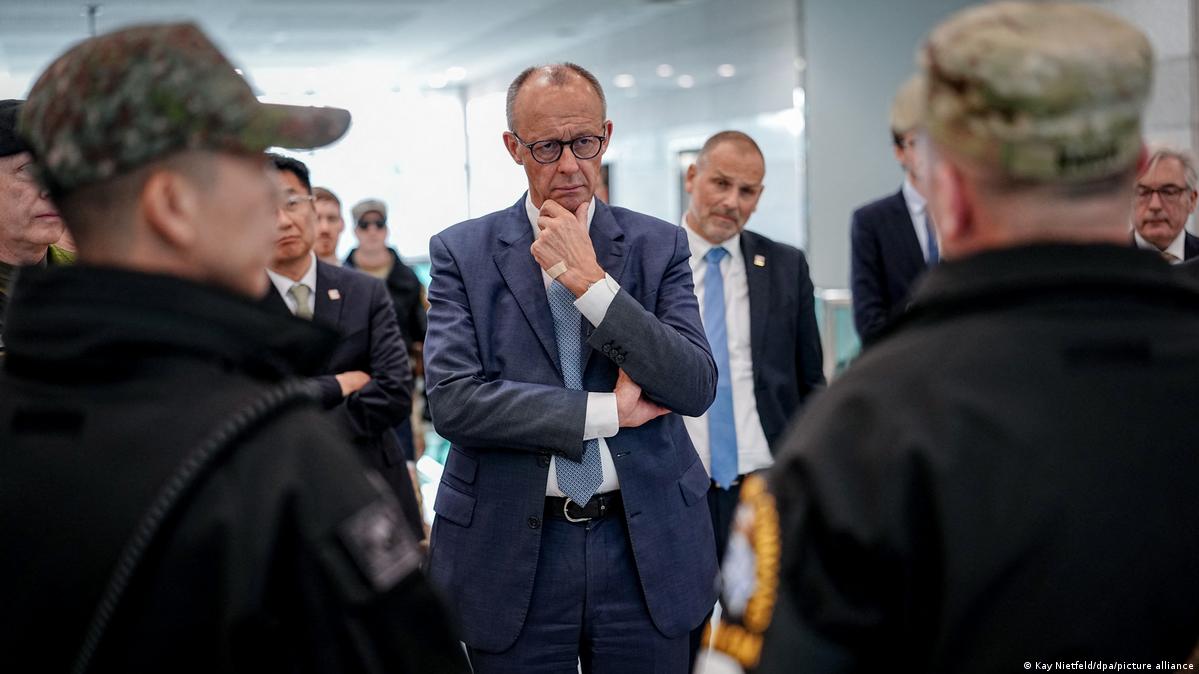
On Friday, 30 October 2026, German Chancellor Friedrich Merz addressed the Asia-Pacific Conference of German Business in Seoul. He warned that the European Union’s “Made-in-Europe” initiatives risk becoming a new wave of protectionism and pledged to bring the concerns voiced by Asian partners back to both Berlin and Brussels.
02
Background & Context
The remarks came amid heightened competition between the United States and China, which Merz described as “ramping up” through tariffs, technological decoupling and a race for critical raw materials. The EU’s Industrial Accelerator Act, intended to boost domestic manufacturing and reduce reliance on China, has sparked anxiety among non-European trading partners that it could create hidden trade barriers.
Visual evidence
Images from the story
03
Data & Statistics
- Delegation size: 30 German business leaders.
- Memoranda of understanding signed in Seoul: 9 agreements covering electricity, energy and bio-health.
- German corporate presence in Singapore: ? 2,400 companies.
- German investment in China: €110 billion total, with a €5.6 billion increase in the first half of the year.
- German exports to China fell from €107 billion to €81 billion since 2022.
04
Official Statements & Responses
Merz emphasized that Europe must stay open to trade if German and European products are to succeed in Asian markets. He said supply-chain politicisation threatens growth, prosperity and regional security. South Korean Prime Minister Han Seong Sook echoed the sentiment, noting that German firms use Korea as a hub to expand throughout the Asia-Pacific. The South Korean Industry Ministry confirmed the nine MoUs and highlighted the partnership’s focus on startups and market entry.
05
Why It Matters
Merz’s push for a multilateral trade alliance seeks to reshape the global economic order at a time when the WTO is perceived as “largely paralysed.” By linking the EU’s free-trade agreements more closely and pursuing new deals with blocs such as ASEAN and the CPTPP, the EU aims to offer Asian partners alternatives to the US-China rivalry.
06
Timeline
- 30 October 2026 – Merz delivers the Seoul speech, raises EU protectionism concerns, and announces plans to relay them to Brussels.
- Earlier in the week – Stops in Singapore and Japan, where Merz advocated for an EU-CPTPP free-trade agreement and highlighted “de-risking” strategies.
07
Verbatim Quotes
- “We are resolutely joining forces against unilateralism, autocratic power politics and violations of international law,” — Friedrich Merz, German Chancellor
- “There is a fear that we might be facing ?a new wave of European protectionism - that we are closing ?ourselves off from other nations,” — Friedrich Merz, German Chancellor
08
What’s Next
Merz will present Asian partners’ concerns to EU policymakers in Brussels, where the Industrial Accelerator Act remains under negotiation. The EU is expected to finalize the act’s text by 2027.