
Full Breakdown
Abdul El-Sayed vs. Mike Rogers: Michigan Senate Race Heats Up Amid Faith-Based Attacks
By Drooid · · How we work
In this breakdown
01
Core Event – Final Stretch of a Contested Senate Campaign
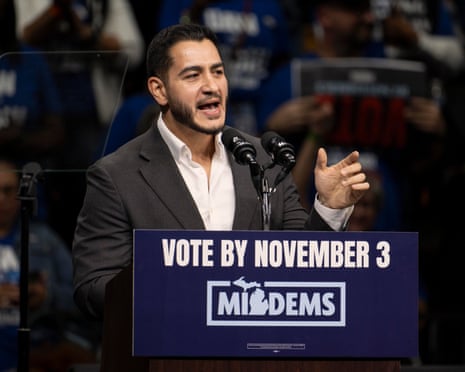
The 2026 U.S. Senate race in Michigan pits Democratic nominee Abdul El-Sayed against Republican former congressman Mike Rogers. With Election Day approaching, the contest has entered its last week. Recent polling shows El-Sayed holding a narrow advantage: the Mitchell poll reports a 7-point lead, a Real Clear Politics tally places him just over three points ahead, and CBS Detroit and a CNN/SSRS poll each cite a 7-point margin. The race is viewed as pivotal for control of the Senate.
Watch
Related reporting
cbsnews
Video: Watch: Michigan voters discuss Senate race
02
Background & Context
El-Sayed, a former Wayne County health director and 2018 gubernatorial primary candidate, is the son of Egyptian immigrants and would become the first Muslim U.S. senator if elected. His public-health career, Rhodes scholarship, and endorsements from progressive figures such as Sen. Bernie Sanders and Rep. Alexandria Ocasio-Cortez contrast with longstanding Republican attacks that frame his faith as a security risk.
Republican criticism draws on a 2012 open letter El-Sayed signed as a medical student, which opponents falsely portray as a pledge to the Muslim Brotherhood—a claim first advanced by activist Laura Loomer and amplified by President Donald Trump, Vice-President J. D. Vance, and Sen. Bernie Moreno. Separate controversy stems from sermons at mosques El-Sayed has attended; videos removed by the Muslim Community Association of Ann Arbor featured an imam praising a Hamas leader, prompting criticism from Robert Spencer of Jihad Watch.
Visual evidence
Images from the story


03
Official Statements & Responses
El-Sayed has emphasized that his policy agenda—affordable groceries, universal health care, and tax reforms—should not be conflated with foreign policy or religious identity. Sen. Elissa Slotkin framed the election as a choice between “team fight” and “team flight,” urging voters to keep both Senate seats Democratic.
Rogers, while avoiding overt slurs, questioned El-Sayed’s loyalties, asking, “Are you for America, or are you for these terrorist groups overseas?” Sen. Bernie Moreno argued that El-Sayed “cannot be near Washington, DC,” invoking a religious test narrative.
04
Criticism & Opposition
- President Donald Trump labeled El-Sayed a “jihadist.”
- J. D. Vance called El-Sayed “very, very evil.”
- Mike Rogers framed the issue as a national-security question.
- Bernie Moreno asserted that El-Sayed’s religious beliefs disqualify him from office.
- Robert Spencer condemned the mosque sermons as evidence of pro-Hamas sentiment.
05
Conflicting Reports & Gaps
- Muslim Brotherhood ties: The 2012 letter contains no mention of the Brotherhood, yet Republican ads claim he “publicly supported these terrorists.” The Guardian notes the letter merely urged Egyptian President Mohamed Morsi to purge remnants of the former regime.
- Family involvement: Social-media posts from El-Sayed’s half-sister in June 2012 reference her mother’s 1970s activism with the Brotherhood, but El-Sayed maintains he was not raised by his mother and denies any personal connection.
- Mosque sermons: Videos of imam remarks were removed after criticism, but the full context remains unclear, leading to divergent interpretations of El-Sayed’s religious affiliations.
06
What’s Next
Voters will cast ballots later this month. The outcome will determine whether Democrats retain or gain a Senate majority and will test the impact of religion-based campaign rhetoric in a closely divided swing state. Both campaigns continue to mobilize volunteers, with El-Sayed scheduled to appear in Detroit alongside Rep. James Clyburn and Rogers planning final outreach to Black voters in Wayne County.