
Full Breakdown
Oleshky Evacuation: A Humanitarian Ceasefire Amid Ongoing War
By Drooid · · How we work
In this breakdown
01
Core Event
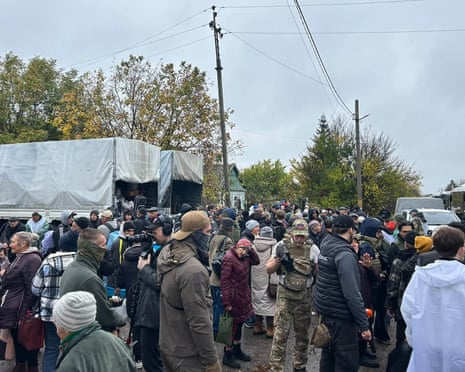
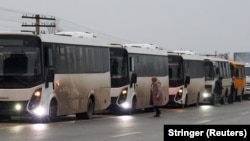
On October 30 2026 a joint Russian-Ukrainian convoy began evacuating civilians from Oleshky, a Russian-occupied town in Kherson. The operation, enabled by a localized ceasefire brokered by U.S. First Lady Melania Trump, moved residents who chose to travel to either Russian-controlled or Ukrainian-controlled territory. The convoy comprised 25 buses with 750 seats, ambulances for people with limited mobility, and medical personnel.
Watch
Related reporting
kyivindependent
Oleshky evacuation begins but volunteer claims Russia already moved people outside of agreed terms
brightcove
Aid convoy enters besieged Ukrainian town Oleshky
akamaized
First lady Melania Trump secures ceasefire for Ukrainian city
02
Background & Context
Oleshky has been under Russian control since February 2022. The town’s pre-war population of about 24,000 fell dramatically after years of fighting and the June 2023 flooding caused by the Kakhovka dam breach. By late October 2026 only a few thousand residents remained, facing severe shortages of food, water, medicine, electricity and heating. The United Nations and Red Cross noted limited access for aid.
Visual evidence
Images from the story




03
Timeline
- October 27 2026 – Localized ceasefire covering Oleshky and surrounding areas began, with de-mining operations launched.
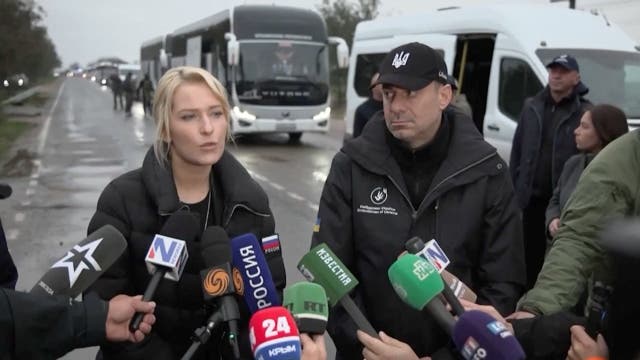
- October 29 2026 – Ukrainian human rights commissioner Dmytro Lubinets and Russian commissioner Yana Lantratova traveled together from Armiansk (Crimea) to Oleshky to coordinate the mission.
- October 30 2026 – The humanitarian convoy arrived; evacuation buses began boarding residents. The ceasefire was reported as holding without incident.
- November 1 2026 (deadline) – Ceasefire scheduled to end at 22:59 local time.
04
Official Statements & Responses
Lubinets said “everyone who wishes to leave Oleshky will be given the opportunity to leave safely… those who have decided to stay can stay and will receive all the necessary humanitarian support.” Lantratova echoed that both sides were “fully honoring their commitments” and that the operation was proceeding “without incident.” President Volodymyr Zelensky called the ceasefire “much-needed calm” for Kherson.
05
Criticism & Opposition
John Foreman, a former U.K. defense attaché, argued that the ceasefire serves Russian propaganda interests, allowing Moscow to portray itself as a humanitarian actor while gaining political leverage with the United States.
06
On-the-Ground Reports
Residents described extreme hardship. One woman recounted that her grandmother’s sister lost her legs after stepping on a landmine and was taken to the hospital in a garden wheelbarrow. Another resident, Olena, said many elders refused to leave because of concerns for their animals. Video footage released by both delegations showed tearful locals greeting officials and boarding buses, while some chose to remain, citing fear of “filtration” or lack of transport for pets.
07
Conflicting Reports & Gaps
- Number of evacuees: Ukrainian officials initially cited 527 residents heading to Ukrainian-controlled territory, later retracting the figure as “uncertain.” Independent outlets reported up to 6,000 people still in Oleshky, while other sources mentioned roughly 2,000.
- Exact route details: The convoy’s route—through Russian-annexed Crimea to the Russian city of Anapa, then by plane to Belarus before entering Ukraine’s Chernihiv region—has been confirmed, but precise timing and logistics remain undisclosed.
- Compliance monitoring: The International Committee of the Red Cross reported it had not been invited to observe, leaving independent verification of the ceasefire’s implementation limited.
08
What’s Next
The ceasefire expires on November 1 2026. Ukrainian officials indicated that three-way peace talks are slated to resume in early November in Abu Dhabi, with the United States seeking to maintain momentum from the Oleshky operation. Both sides have signaled a willingness to keep the humanitarian corridor open for additional aid deliveries, but no further extensions have been announced.