
Full Breakdown
Tensions Rise Between Michigan Senate Nominees Over Israel-Related Campaign Ads
By Drooid · · How we work
In this breakdown
01
Core Conflict Ahead of the Election
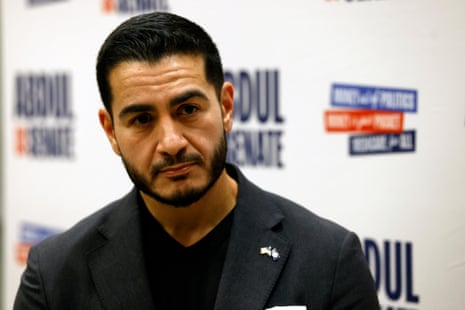
In the final days before Michigan voters head to the polls, Democratic Senate nominee Abdul El-Sayed and former primary opponent Rep. Haley Stevens (D-Mich.) have exchanged sharp statements over an advertisement produced by the independent progressive group Rebellion PAC. Stevens demanded that El-Sayed denounce the ad, which links rising grocery prices to U.S. military aid to Israel, and also asked him to remove a campaign spot featuring former Fox News host Tucker Carlson. El-Sayed replied that the criticism was an attempt to “re-litigate” a primary that ended months ago and emphasized his focus on affordability and health-care.
02
Background & Context
El-Sayed, a former Detroit health director and medical doctor, won the Democratic primary by a narrow margin—about 1 percentage point, roughly 15,000 votes—defeating Stevens, who was backed by the American Israel Public Affairs Committee (AIPAC) with close to $30 million in outside spending. The primary left the party divided, with Stevens initially endorsing El-Sayed but later pressing him on the Rebellion PAC ad and his own Carlson ad. The two are slated to appear together at a get-out-the-vote event in Detroit on Sunday, following a brief reconciliation at a Democratic unity breakfast.
Visual evidence
Images from the story

03
Timeline
- August 2026 – El-Sayed wins the Democratic primary over Stevens.
- Friday (early October) – Stevens releases a statement demanding an apology for the Rebellion PAC ad; El-Sayed issues a rebuttal accusing Stevens of relitigating the primary.
- Sunday (the weekend before the election) – Planned joint rally in Detroit with senior Democratic leader Rep. Jim Clyburn.
- July 7 2026 – El-Sayed and Stevens appear on a televised debate in Grand Rapids.
04
Data & Statistics
- A Marist poll released a week before the election shows El-Sayed at 50 % and Republican nominee Mike Rogers at 48 % among likely voters.
- Earlier Mitchell Research polling gave El-Sayed 51 % versus Rogers 44 %, with independent voters favoring El-Sayed 52 % to 38 %.
- Outside spending in the race totals more than $70 million, including $30 million from AIPAC supporting Stevens.
05
Official Statements & Responses
Stevens framed the Rebellion PAC ad as “antisemitic” and linked it to Michigan families’ inability to afford groceries, saying she expects El-Sayed to apologize for his own remarks about Israel. She also urged him to pull the Carlson ad out of respect for Michigan’s Black community. El-Sayed countered that his campaign is unaffiliated with the Rebellion PAC ad and highlighted his “people-powered” victory over the massive outside spending. Both candidates’ representatives declined to comment on whether the joint Detroit event will proceed.
06
Verbatim Quotes
- “This ad tells Michigan families they cannot afford groceries because their money has to be set aside for ‘killing Palestinians,’ and it blames our close ally Israel for everything Michiganders cannot afford,” — Rep. Haley Stevens
- “That focus is why our people-powered campaign defeated a historic $70M in outside spending from big corporations and AIPAC on behalf of Congresswoman Stevens,” — Abdul El-Sayed
07
What’s Next
The candidates will appear together at the Detroit rally on Sunday, the first joint public appearance in months, before the November election decides which party will control the U.S. Senate. Both campaigns continue to mobilize voters, with El-Sayed emphasizing affordability, health-care, and ending U.S. aid to Israel, while Stevens stresses the need to “shut out the hate” and maintain support for Israel among her coalition. The outcome will determine whether Michigan’s Senate seat remains in Democratic hands.