
Full Breakdown
US, South Korea, Japan Reaffirm Commitment to Complete Denuclearisation of North Korea
By Drooid · · How we work
In this breakdown
01
Core Event: Joint Trilateral Statement on the G20 Sidelines (October 30)
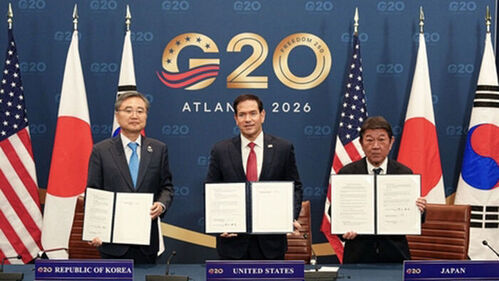
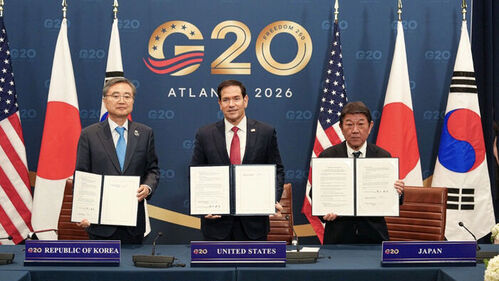
On October 30, foreign ministers Marco Rubio (U.S. Secretary of State), Cho Hyun (South Korean Foreign Minister) and Toshimitsu Motegi (Japanese Foreign Minister) met on the margins of the Group of 20 foreign-ministers’ meeting in Atlanta. The ministers also signed a Memorandum of Cooperation for a Trilateral Arctic-Pacific Partnership (TAPP) to deepen maritime and economic collaboration in the Pacific Arctic.
Watch
Related reporting
brightcove
South Korea says US cancelled upcoming joint marine exercises over Iran war
02
Background & Context
North Korea has maintained a declared, permanent nuclear arsenal despite long-standing UN sanctions backed by the United States, South Korea, Japan, Russia and China. Previous U.S. administrations have sought denuclearisation through diplomatic pressure and sanctions, while recent overtures by President Donald Trump—including a 2025 concession that North Korea was “sort of a nuclear power” and an expressed willingness to meet Kim Jong Un—have introduced a more conciliatory tone. Analysts note that South Korean President Lee Jae Myung has advocated a temporary freeze on North Korea’s nuclear programme in exchange for sanctions relief, a stance critics argue could legitimize the regime’s nuclear status.
Visual evidence
Images from the story


03
Official Statements & Responses
- The U.S.
- The statement highlighted specific Security Council provisions that ban activities supporting revenue for North Korea’s nuclear and ballistic-missile programmes.
- The three ministers also praised the work of the Multilateral Sanctions Monitoring Team (MSMT), which tracks violations of UN sanctions, and emphasized the importance of peace and stability across the Taiwan Strait.
04
Why It Matters
The reaffirmed commitment underscores continued U.S., South Korean and Japanese resolve to enforce sanctions and pressure Pyongyang, while the TAPP memorandum expands cooperation in the Pacific Arctic—a region of growing strategic competition. The joint stance also signals to regional actors, including China and Russia, that the three democracies remain aligned on non-proliferation despite divergent diplomatic approaches toward the North.
05
What's Next
Speculation persists that President Donald Trump could seek a meeting with Kim Jong Un at the upcoming APEC summit in China, scheduled for next month. If such a summit occurs, it would represent the first high-level U.S.–North Korea engagement since the 2019 Hanoi summit and could influence the trajectory of denuclearisation talks. Meanwhile, the three foreign ministers will continue trilateral consultations, building on the TAPP framework and reviewing implementation of the small-modular-reactor memorandum signed in Ankara, Turkey, on July 7.