
Full Breakdown
100th U.S. Spacewalk Powers ISS Upgrade
By Drooid · · How we work
In this breakdown
01
Core Event: Installation of the Seventh Roll-Out Solar Array
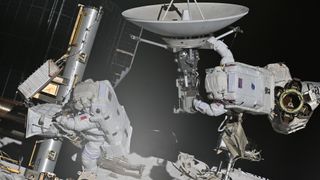
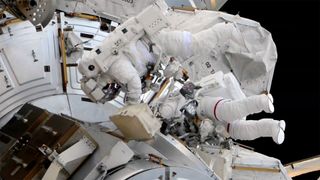
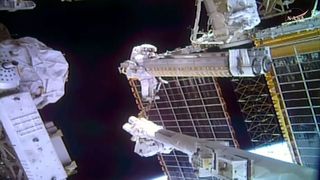
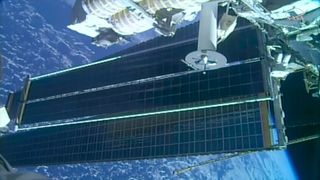
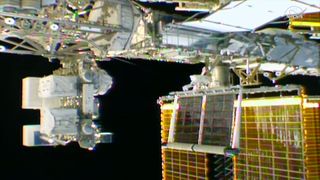
On October 29 2026, NASA astronaut Anil Menon and Canadian Space Agency (CSA) astronaut Joshua Kutryk performed a 7-hour-11-minute extravehicular activity (EVA) from the International Space Station’s (ISS) Quest airlock. Working together with the station’s Canadarm2 robotic arm, the pair unbolted, positioned, and released a 750-pound (340 kg) International Space Station Roll-Out Solar Array (iROSA) on the port-side truss. The array self-unfurled to its full 63-foot (19-meter) length without a motor, adding a new power-generation wing to the aging station.
02
Background & Context
The ISS’s original eight solar array wings have exceeded their 15-year design life, reducing overall power output. Beginning in 2021, NASA launched a five-year upgrade that adds pairs of flexible iROSA panels to supplement the legacy arrays. The new panels are lighter, stored rolled-up on a spool, and deploy using stored potential energy. The upgrade is intended to raise the station’s power capacity by up to 30 % and to provide the surplus needed for ongoing operations and the planned safe, controlled deorbit scheduled for 2030.
Visual evidence
Images from the story



03
Data & Statistics
- EVA duration: 7 h 11 min
- iROSA mass: 750 lb (340 kg)
- Deployed length: 63 ft (19 m)
- Power increase from iROSA pairs: 20 %–30 % (per NASA)
- Reported capacity boost: 160 kW -> 215 kW (CSA) vs. ?152 kW -> ?200 kW (other outlets)
04
Official Statements & Responses
Mission control in Houston described the EVA as “essentially flawless.” CSA officials highlighted the collaborative effort, noting that capcom Jenni Gibbons and the CSA Robotics Mission Control Centre in Longueuil provided real-time guidance, while Canadian robotics contributed directly through Canadarm2.
05
Verbatim Quotes
- “Being outside, I can say it is always sunny in space,” — Anil Menon, at the conclusion of Thursday's EVA
- “A spacewalk is, for many astronauts, it's the peak of their career,” — David Saint-Jacques
- “Josh, I know you're gonna do a good job. You've got this.” — David Saint-Jacques
- “From Luke and I on the other side of the hatch, good luck. We’re proud of you and we’ll see you on the other side,” — Jessica Watkins
- “Canada delivers. And so I’m very, very proud of our space sector,” — David Saint-Jacques
06
Conflicting Reports & Gaps
Sources differ on the exact power-capacity figures after the iROSA upgrades. The Canadian Space Agency reports a rise from 160 kW to about 215 kW, whereas other reporting outlets cite an increase from roughly 152 kW to about 200 kW. Both figures are presented as estimates from credible agencies, but the discrepancy remains unresolved.
07
What’s Next
A second EVA is scheduled for November 5 to install the eighth and final iROSA, completing the upgrade campaign that began in 2021. Once all eight panels are in place, the ISS is expected to achieve the projected 30 % power-generation boost, securing sufficient energy for its remaining operational lifespan.