
Full Breakdown
Suspension of Poland’s Constitutional Tribunal President Sparks Standoff
By Drooid · · How we work
In this breakdown
01
The Suspension and Immediate Fallout
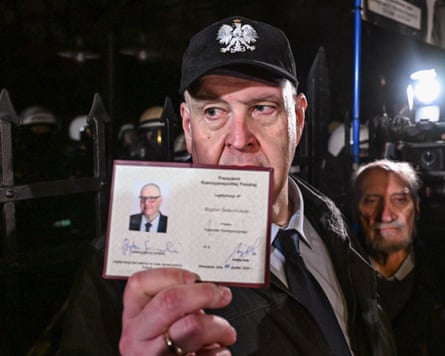
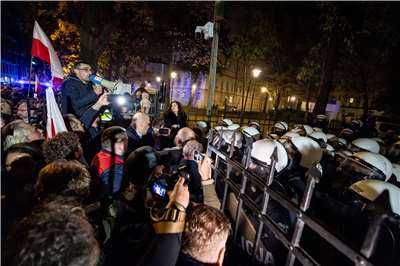
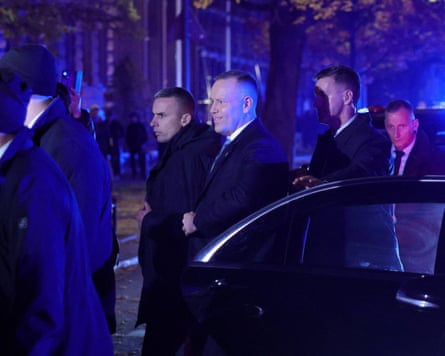
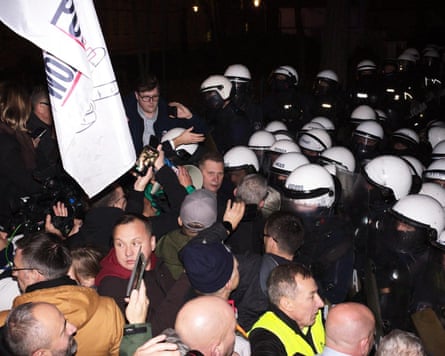
On October 30, the Constitutional Tribunal announced that its longest-serving judge, Anna Korwin-Piotrowska, had suspended Bogdan Swieczkowski, the tribunal’s president, and his deputy Bartlomiej Sochanski for one month, citing seniority under Article 130 of the Law on the Organisation of Common Courts. Police secured the tribunal’s entrance and detained three protesters after a fence breach. President Karol Nawrocki, travelling to Senegal, turned his plane back, posting that “at a moment like this, the president must be in Poland.” He arrived in Warsaw that night, entered the tribunal building, and called the events a forcible takeover of a constitutional institution.
Watch
Related reporting
brightcove
Protests outside Poland’s constitutional court: What’s the crisis about?
02
Background & Context
The dispute traces to 2015, when the nationalist Law and Justice (PiS) party appointed judges to seats already filled by the outgoing centrist government, creating a parallel bench. The European Court of Human Rights (2021) and the Court of Justice of the European Union (2025) ruled that the tribunal no longer met standards of independence. After PiS lost power in 2023, Prime Minister Donald Tusk pledged to restore judicial independence, but President Karol Nawrocki—elected in 2025 and aligned with PiS—has repeatedly vetoed judges appointed by the current parliamentary majority.
Visual evidence
Images from the story


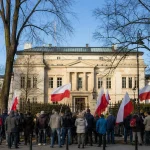
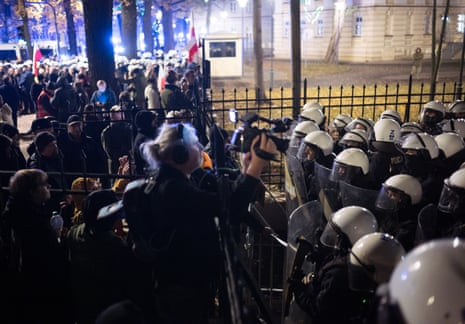
03
Timeline
- October 30 – President returns; suspension of Swieczkowski and Sochanski announced.
- October 31 – Nawrocki arrives at the tribunal, confronts police, and enters the building.
- November 3 (scheduled) – Judges’ assembly called by Korwin-Piotrowska to address the tribunal’s functioning.
04
Official Statements & Responses
- Prime Minister Donald Tusk posted on X that restoring the rule of law is a governmental duty and described the process as difficult and requiring decisive action.
- Justice Minister Waldemar Zurek said he had requested the lifting of immunity for Swieczkowski and Sochanski to allow criminal proceedings for obstructing the tribunal’s work.
- The Constitutional Tribunal’s X account labeled the suspension a “coup d’état” and warned that participants were committing the crime of a coup.
05
Criticism & Opposition
- Jaroslaw Kaczynski, leader of PiS, condemned the suspension as an assault on the court and called it a coup.
- Wojciech Przybylski, editor-in-chief of *Visegrad Insight*, argued the previous PiS government used the tribunal to push its ideological agenda.
06
Conflicting Reports & Gaps
- Some outlets reported that the tribunal’s website went offline after the suspension announcement, preventing independent verification of the official rationale.
- Swieczkowski disputes Korwin-Piotrowska’s authority, noting she has not taken the presidential oath required to assume the role.
- No court ruling has yet clarified the legality of the suspension, leaving the institutional status unresolved.
07
Why It Matters
The Constitutional Tribunal decides whether Polish laws comply with the constitution and can overrule legislation that conflicts with EU law. Its paralysis threatens Poland’s compliance with EU rule-of-law standards and could jeopardise EU funding. The standoff also heightens political polarization ahead of the 2027 parliamentary election, with both sides using the crisis to mobilise their bases.
08
What’s Next
- The November 3 judges’ meeting could determine whether the tribunal can achieve a quorum and resume its duties.
- The government’s request to lift the immunity of the suspended judges remains pending before the prosecutor-general’s office.
- International observers, including the U.S. ambassador, have warned that the situation is “very serious” and could destabilise Poland’s democratic institutions.