
Full Breakdown
A Spectrum of Surprise: White Dwarfs Reveal Unexpected Colors
By Drooid · · How we work
In this breakdown
01
Core Discovery – Colors Beyond White
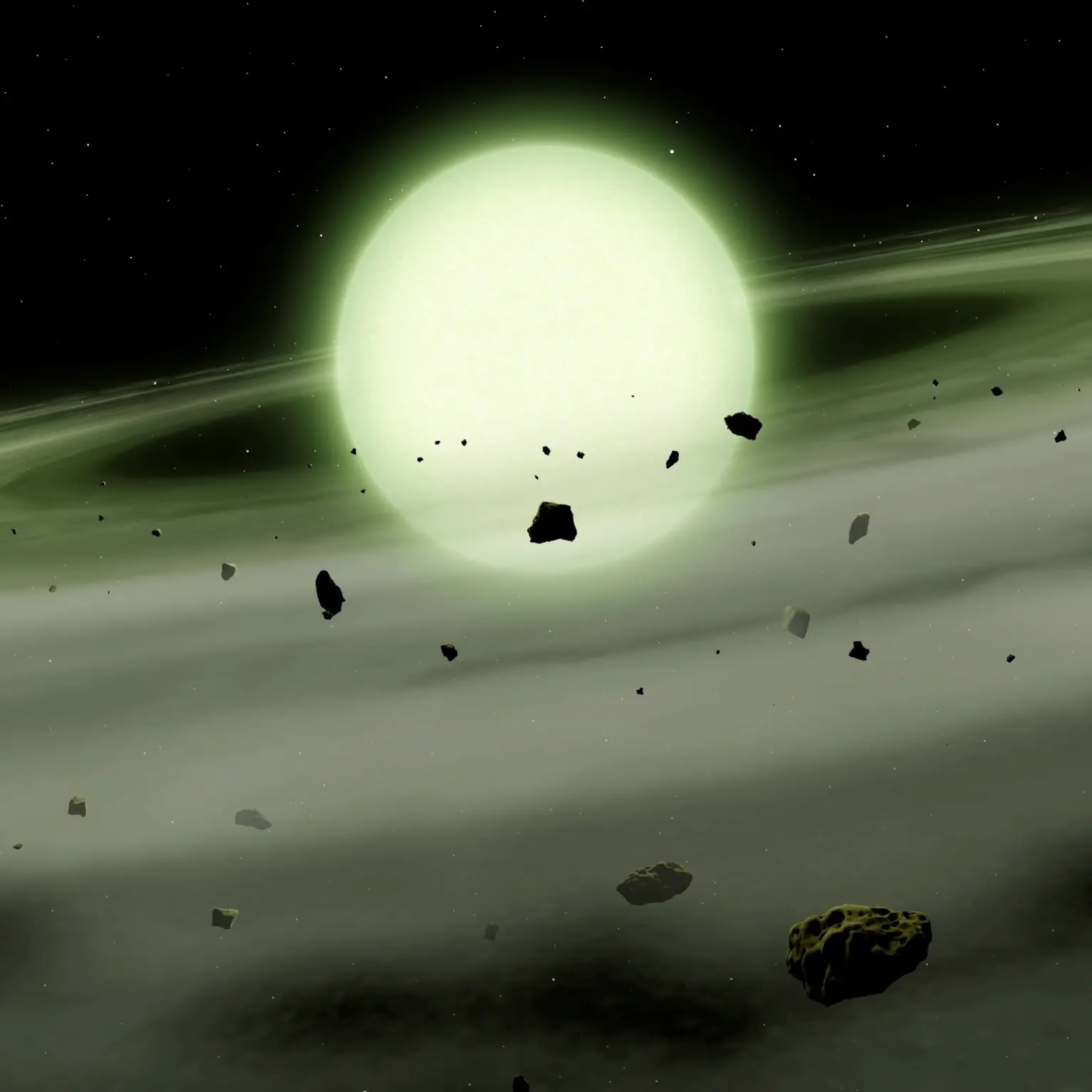
Astronomers have identified that a subset of white dwarfs—stellar remnants roughly Earth-sized but with the Sun’s mass—display vivid hues such as pink, green, purple, yellow and cyan rather than the traditionally observed white-to-blue tones. The finding comes from a study published in *RAS Techniques and Instruments* that converted the electromagnetic spectra of many white dwarfs into the palette perceived by the human eye. The analysis highlighted several objects, most notably WD J1330+6435, whose calculated appearance would be green.
02
How Dense Atmospheres Alter Light
White dwarfs possess surface gravities so extreme that their outer layers are compressed to liquid-like densities, approaching one gram per cubic centimetre—about a million times denser than the Sun’s atmosphere. Under these conditions, trace elements such as carbon, calcium, sodium and lithium interact with the dense helium plasma, absorbing broad bands of light. The removal of specific wavelengths reshapes the remaining spectrum, allowing colors other than white or blue to dominate. Mark Hollands, an astronomer at the University of Warwick and co-author of the study, noted that the absorption can be strong enough to change the overall hue perceived by observers.
Visual evidence
Images from the story

03
Planetary Debris as a Color Catalyst
The research also links unusual colors to the accretion of material from former planetary systems. When a star evolves into a red giant, nearby planets and asteroids can be destroyed; the resulting debris may later fall onto the white dwarf’s surface. Elements released from this rocky material—particularly sodium, calcium and lithium—further modify the atmospheric composition. Sodium, for example, absorbs large portions of orange light, shifting the star’s output toward green. Carbon enrichment has been associated with pink or purple shades.
04
Implications for Stellar Classification
These findings challenge the long-standing view that a star’s color is determined solely by temperature. While hotter stars appear bluer and cooler ones redder, the chemical makeup of a white dwarf’s dense atmosphere now appears to play a decisive role in its visual appearance. Consequently, astronomers may need to revise classification schemes that rely on color as a proxy for temperature alone, incorporating spectroscopic signatures of atmospheric pollutants.
05
Future Directions
The team plans to extend the colour-mapping technique to a larger sample of white dwarfs, aiming to quantify how common such chromatic diversity is across the population. By correlating specific elemental abundances with observed hues, researchers hope to better understand the fate of planetary systems after their host stars die and to refine models of white-dwarf atmospheres.