
Full Breakdown
Michigan Senate Race Heats Up: Islamophobic Attacks, Democratic Unity, and a Tight Vote
By Drooid · · How we work
In this breakdown
01
Core Event – Final Campaign Push and Islamophobic Rhetoric
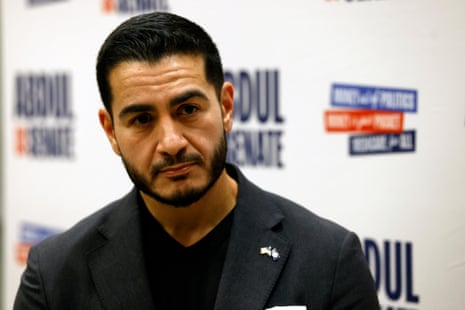
In the final days before the November 3 election, Michigan’s open U.S. Senate seat has become a flashpoint for partisan conflict. Republican President Donald Trump and GOP surrogates have repeatedly labeled Democratic nominee Abdul El-Sayed a “jihadist” and a “member of the Muslim Brotherhood,” using his faith as a central campaign theme. El-Sayed, a Michigan-born son of Egyptian immigrants, has dismissed the attacks as distractions from issues such as gas prices, groceries, and health-care costs.
02
Background & Context – Primary Fallout and Party Divisions
El-Sayed secured the Democratic nomination in August by narrowly defeating former congresswoman Haley Stevens, a candidate backed by AIPAC with roughly $30 million in ad spending. The primary left lingering tensions: Stevens’ fiancé Jason Turkish announced support for Republican Mike Rogers, while Stevens later reaffirmed her vote for El-Sayed but urged the campaign to “shut out the hate.” These frictions have been amplified by El-Sayed’s past remarks on Israel and his association with streamer Hasan Piker, prompting concern among some Jewish voters.
Visual evidence
Images from the story

03
Data & Statistics – Polls, Spending, and Early Voting
- A Marist poll placed El-Sayed at 50 % and Rogers at 48 % among likely voters.
- RealClearPolitics averages show El-Sayed leading Rogers by five points.
- Rogers outspent El-Sayed by nearly two-to-one as of early October.
- Early-voting turnout reached 1,392,170 Michigan voters (18.8 % of active registrants), with over 1.1 million casting absentee ballots.
04
Official Statements & Responses – Democratic Leaders and Republican Counterpoints
Democratic figures have rallied publicly. Former President Barack Obama addressed a crowd at Cass Technical High School, defending El-Sayed against “lies, fearmongering and division.” Senator Bernie Sanders called the Republican ads “racist and disgusting” and rooted in Islamophobia.
Republican leaders have countered with accusations of anti-Jewish sentiment. Mike Rogers told the Jewish Telegraphic Agency that El-Sayed is “anti-Jew,” a charge El-Sayed rejects. Senator Ted Cruz labeled Democratic opponents as “self-proclaimed communists and Islamists.”
05
Criticism & Opposition – Republican and Some Jewish Community Concerns
Trump’s rallies in Port Huron featured the repeated use of “jihadist” and “terrorist” language, and he accused El-Sayed of bringing “radical ideology” to Congress. AIPAC’s $30 million investment in Stevens’ primary campaign underscores the intensity of pro-Israel lobbying in the race. Rabbi Aaron Starr of Congregation Shaarey Zedek criticized a Rebellion PAC ad linking U.S. policy to extremist rhetoric.
06
Verbatim Quotes – Impactful Voices
- “They resort to lies, fearmongering and division,” — Barack Obama
- “Make people who are in my coalition feel comfortable about coming to the polls,” — Haley Stevens
- “We are one week away from the election, and it feels like the temperature has turned way up,” — Rabbi Aaron Starr
07
Conflicting Reports & Gaps – Poll Discrepancies and Unresolved Issues
Two polling aggregates present different margins: the Marist poll shows a two-point lead for El-Sayed, while RealClearPolitics averages a five-point lead. Neither source provides a breakdown of demographic support, leaving uncertainty about how Jewish and Black voter blocs may influence the outcome.
08
What’s Next – Election Day and Potential Outcomes
Early voting began on January 6, marking the first day voters could cast in-person ballots. The race will be decided on November 3, when Michigan voters will choose whether the state’s first Muslim U.S. senator is elected, a result that could affect Senate control and signal the impact of Islamophobic campaign tactics on electoral dynamics.